How to store emergency equipment in a small car starts with keeping high-use items reachable, heavy items secured, and safety gear outside airbag and pedal paths. Build one compact kit for roadside problems, then place larger or less urgent items in protected cargo space. Storage must fit your vehicle’s model year, body style, passenger count, and power system.
Key takeaways
- Keep a first-aid kit, warning device, flashlight, phone cable, and gloves within quick reach.
- Secure tools and battery packs so they cannot become projectiles during hard braking.
- Keep dashboard, steering wheel, pedals, seat tracks, and airbag zones clear.
- Store lithium battery packs within their temperature limits and inspect cables often.
- Pack for your climate, road conditions, medical needs, and likely travel routes.
- Do not rely on an emergency kit to replace roadside assistance or professional repair.
Why small-car storage needs a plan
Small cars have limited trunk depth, narrow side pockets, and little space below seats. A loose bag can block cargo access or slide into the driver’s footwell. A large tool case can reduce rear visibility or prevent a passenger from exiting.
Storage also affects equipment condition. Heat can damage medications, adhesives, power banks, and some electronic devices. Moisture can corrode tools, batteries, jumper cable clamps, and electrical connectors. Cold can reduce battery output and make some plastics brittle.
Start with access, safety, and frequency. Items needed during a breakdown should not sit beneath groceries or a full luggage load. Items used once per season can stay deeper in the cargo area, but they still need restraint.
How to store emergency equipment in a small car
1. Map usable storage areas
Read your owner’s manual before using hidden compartments, under-seat space, or cargo tie-down points. Model-year changes can alter airbag locations, seat wiring, battery placement, and allowable storage areas.
Inspect these zones:
- Glove box, for small medical and communication items.
- Center console, for a flashlight, cable, or compact first-aid supplies.
- Door pockets, for light items only. Avoid heavy tools that could strike occupants.
- Rear cargo floor, for the main emergency bag.
- Spare-tire well, for low-use equipment if your vehicle has one.
- Factory cargo pockets, for flat and restrained items.
Do not place equipment near seat-mounted airbags, curtain-airbag deployment zones, pedal movement, steering-column movement, or seat rails. Never wedge objects between a seat and door where they could affect airbag deployment.
2. Divide gear by urgency
Use three groups. Group one contains items needed while stopped near traffic. Group two contains tools for a basic roadside problem. Group three contains seasonal or extended-trip supplies.
| Group | Examples | Best storage position |
|---|---|---|
| Immediate access | Reflective warning device, flashlight, gloves, first-aid supplies, phone cable | Console, glove box, or top of secured cargo bag |
| Roadside tools | Tire inflator, pressure gauge, jump starter, basic hand tools | Secured cargo floor or factory storage compartment |
| Seasonal and trip gear | Blanket, water, extra clothing, traction aid, rain gear | Lower cargo area, protected from leaks and shifting loads |
Keep the warning device and flashlight reachable from inside the car. You may need them before opening the trunk, especially on a dark shoulder or a busy road.
3. Use one compact, labeled bag
A soft-sided bag fits small cargo areas better than a rigid box. Choose a bag with separate sections or add bright labels. Labels reduce searching when visibility is poor or stress is high.
Use a bright color for the roadside kit. Keep medical supplies in a sealed inner pouch. Place electrical items in a separate pouch so wet gloves or leaking bottles cannot contact chargers, clamps, or battery terminals.
Do not overfill the bag. An overloaded kit becomes hard to carry and may hide damaged supplies. Keep the heaviest items low, close to the cargo floor, and near factory tie-down points.
4. Secure heavy and hard objects
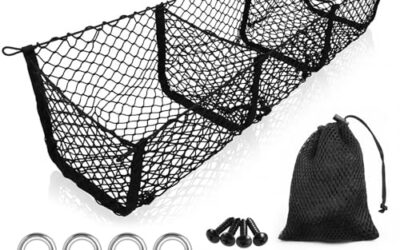
Loose equipment can move forward during sudden braking. A tire inflator, metal tool, or jump starter can damage interior parts or injure an occupant. Use a cargo net, strap, closed compartment, or fitted organizer.
Do not attach straps to seat belts, headrests, child-seat anchors, or wiring unless your vehicle manual allows that use. Child-seat anchors have specific functions. They are not general cargo tie-down points.
Keep sharp tools capped or wrapped. Store jumper cable clamps so they cannot contact each other or exposed metal. Protect tire plugs, blades, and folding tools from opening inside the bag.
5. Protect batteries and electronics
Jump starters, power banks, radios, and rechargeable flashlights need special care. Follow each device’s charging, storage, and temperature instructions. Vehicle interiors can become much hotter or colder than outdoor air.
Do not leave a swollen, cracked, leaking, or unusually hot battery pack in the car. Remove it from service and follow local rules for battery disposal. Do not charge a damaged pack.
Check connector fit before an emergency. USB-A, USB-C, Lightning, and proprietary connectors are not interchangeable in every setup. A phone may also require a compatible cable, charging protocol, or adapter. Android and iPhone users may need different cables, and some vehicles support only certain USB ports for charging.
Keep cables coiled without tight bends. Inspect insulation for cuts. A charging cable that works with one phone may not support the power level or data connection required by another device.
6. Pack equipment for your climate
Cold-weather drivers may need gloves, a warm layer, traction material, an ice scraper, and a compact blanket. Snow and ice can hide the ground around a disabled vehicle. Keep footwear suitable for standing beside the road.
Hot-weather drivers may need extra drinking water, sun protection, and a way to protect electronics from direct heat. Water stored in a vehicle must stay sealed and should be replaced on a regular schedule.
Wet climates call for sealed pouches and corrosion checks. Desert travel can require more water and shade. Rural routes may justify more food, lighting, and communication backup than short urban trips.
7. Keep visibility and exit paths clear
Do not stack bags against rear glass. Blocked windows reduce visibility during lane changes and reversing. Cargo should remain below the vehicle’s safe sight line unless the owner’s manual allows another arrangement.
Keep door pockets, footwells, and the space between seats clear enough for normal entry and exit. Never place equipment beneath a driver’s pedals. A mat, cable, or tool can interfere with brake or accelerator movement.
Do not place loose gear on top of a dashboard or parcel shelf. It can reflect in the windshield or become a projectile. Avoid covering warning lights, defroster vents, and camera or sensor areas.
What to keep in a compact emergency kit
Build the kit around likely problems, not every possible disaster. A practical core kit can include:
- Flashlight with spare batteries or a charged rechargeable light.
- Reflective warning device suitable for roadside use.
- Work gloves and disposable gloves.
- Basic first-aid supplies and personal medication needs.
- Phone charging cable and compatible vehicle adapter.
- Small blanket, rain layer, and drinking water.
- Tire pressure gauge and tire inflator if compatible with the vehicle’s tire valve and power outlet.
- Jump starter or jumper cables suited to the vehicle’s battery system.
- Basic hand tools that match fasteners used on your vehicle.
- Paper contact information and vehicle details if phone service fails.
A tire inflator may use a 12-volt outlet, USB power, or a separate battery. Check connector type, fuse limits, and outlet location. Some vehicles disable accessory power when switched off. A jump starter for a conventional 12-volt battery is not automatically suitable for every hybrid or EV system.
Electric vehicles and hybrids need extra care. Their high-voltage systems have different service procedures, towing rules, and shutdown conditions. Do not open high-voltage compartments or attempt repairs without vehicle-specific training. Store the charging cable according to its manual, keep its connector dry, and follow the vehicle maker’s towing instructions.
Build a storage layout
- Remove clutter from glove box, console, cargo floor, and spare-tire area.
- Read the vehicle manual for airbag, seat, cargo, battery, and tie-down warnings.
- Place immediate-access supplies in one small labeled pouch.
- Put heavy tools low and secure them with approved cargo restraints.
- Separate medical supplies from wet, sharp, dirty, and electrical items.
- Test flashlights, chargers, inflators, and jump starters outside an emergency.
- Load normal luggage, then check rear visibility, pedal clearance, and exit paths.
- Review the kit when seasons change or passengers and travel routes change.
Common mistakes
Keeping everything in the trunk
A trunk-only kit may be unreachable after a collision, while stopped in traffic, or when another vehicle blocks the trunk. Keep first-response items inside the cabin and larger tools secured in cargo space.
Using the cabin as a toolbox
Center consoles and door pockets suit light items. They are poor locations for loose metal tools, heavy inflators, or unrestrained battery packs.
Ignoring battery condition
A jump starter with a low charge cannot solve a dead battery. Charge it on its schedule, inspect its case, and check cable condition. Do not assume a dashboard indicator proves full capacity.
Storing supplies without rotation
Bandages, medications, water, batteries, and chemical heat packs have dates or storage limits. Replace expired or heat-damaged items. Personal medication needs should follow medical guidance.
Carrying gear that does not fit the vehicle
A tire inflator may lack the right power connector. Jumper cables may be too short for a particular layout. A warning device may be too large for the available space. Test fit and function at home.
When to get professional help
Call roadside assistance or a qualified technician when the vehicle is in an unsafe location, traffic is close, visibility is poor, or you cannot identify the fault. Move occupants away from traffic when possible and follow local emergency instructions.
Do not work beneath a vehicle supported only by a jack. Do not enter high-voltage areas on an EV or hybrid. Stop using a tire, cable, inflator, charger, or jump starter that shows damage, overheating, smoke, or unusual odor.
A roadside kit cannot fix failed brakes, damaged steering, fuel leaks, high-voltage faults, or a vehicle that will not safely move. It can help you warn traffic, communicate, stay visible, and handle limited low-risk tasks.
Related CarTechTalk guides
For tire equipment, read our guide to the digital tire pressure gauge with memory. Drivers of larger vehicles can compare access needs in our guide to the best tire pressure gauge for dually trucks. Battery-related equipment belongs with the vehicle’s battery type and charging system, so review our battery chargers and testers category.
Gear that can help
If you need jump starters or tire inflators or fast car chargers for this job, these picks already appear in our jump starters guides. Check the full guide for fit and who should skip each one.

Pros
- Supports a stated range of gas and diesel engine sizes
- Combines jump-starting capability with power-bank and emergency-light functions
- Includes reverse-polarity, short-circuit, overheating, overvoltage, overload, deep-discharge, and overcurrent protections
- Provides a built-in handle for portability
Specifications
| Color | Gray-blue |
|---|---|
| Dimensions | 7.4409448743 x 3.6614173191 x 1.7716535415 inches |
| Weight | 1.4109584768 pounds |
| Product Group | Automotive Parts and Accessories |
| Binding | Automotive |
Best For / Avoid If
Best for buyers prioritizing
- Supports a stated range of gas and diesel engine sizes
- Combines jump-starting capability with power-bank and emergency-light functions
- Includes reverse-polarity, short-circuit, overheating, overvoltage, overload, deep-discharge, and overcurrent protections

Pros
- Combines jump-starting, tire inflation, device charging, and emergency lighting in one unit
- Includes USB-C 65W charging and 160W DC continuous output
- Supports tire inflation for pickup trucks and smaller vehicles
- Provides listed protection features and a 24-month warranty
Cons
- Charging adapter is not included
- Vehicle compatibility is limited to the stated 12V system and engines up to 10L
- Amazon listing shows a 4.3 rating from 0 reviews, so review evidence is unavailable
Specifications
| Color | black and grey |
|---|---|
| Size | 4000A MV24A |
| Dimensions | 2.1653543285 x 5.2755905458 x 9.3700787306 inches |
| Weight | 5.3 pounds |
| Product Group | Automotive Parts and Accessories |
| Binding | Automotive |
Best For / Avoid If
Best for buyers prioritizing
- Combines jump-starting, tire inflation, device charging, and emergency lighting in one unit
- Includes USB-C 65W charging and 160W DC continuous output
- Supports tire inflation for pickup trucks and smaller vehicles
Consider another option if
- Charging adapter is not included
- Vehicle compatibility is limited to the stated 12V system and engines up to 10L
- Amazon listing shows a 4.3 rating from 0 reviews, so review evidence is unavailable
Frequently asked questions
Should emergency equipment stay in the trunk?
Large tools can stay in the trunk when secured. Keep a flashlight, warning device, gloves, phone cable, and first-aid supplies inside the cabin for faster access.
Can I store a jump starter in my car year-round?
Usually, but temperature and charge limits vary by model. Follow its manual, protect it from moisture and extreme heat, and inspect it before travel.
Where should I store a flashlight?
Use a console, glove box, or door pocket if the light is restrained and does not interfere with doors, pedals, airbags, or visibility.
What emergency equipment should EV drivers carry?
Carry communication and visibility supplies, a compatible charging cable, weather gear, and water. Follow the EV manual for charging faults, towing, and high-voltage safety.
How often should I check my emergency kit?
Check it when seasons change, before long trips, and after every use. Test electronic items and replace damaged or expired supplies.
Sources and further reading
- Check for Recalls (NHTSA): Use this page to check open safety recalls for your vehicle.
- Tire Safety (NHTSA): Review tire inspection, pressure, and roadside safety guidance.
- Battery Council International: Learn about vehicle battery care, handling, and recycling.