To find manufacturer approved vehicle lift points, check the owner’s manual or service information for your exact vehicle year, make, model, and configuration. Use the diagram and instructions for the lifting task you plan to do; a point shown for a tire change may not apply to lifting the whole vehicle or supporting it on stands.
- Start with the vehicle manual, not a generic diagram or guess based on appearance.
- Check whether instructions cover your vehicle’s body style, drivetrain, and factory equipment.
- Tell apart jacking points, lift locations, and jack-stand support points.
- Do not lift if you cannot identify the specified point or use the required equipment safely.
Where to find manufacturer approved vehicle lift points
The owner’s manual is usually the first place to check. Look in sections covering flat tires, changing a wheel, emergency equipment, or vehicle maintenance. Search the manual’s index or digital text for “jack,” “lifting,” “jacking point,” or “vehicle support.” Follow diagrams and any warnings beside them.
If the owner’s manual does not cover the job, consult service information for the exact model year and vehicle configuration. Service procedures may show additional lift locations for a shop hoist, floor jack, or support stands. Those locations are not automatically interchangeable. A point used to raise one corner may not be approved for supporting the vehicle while you work underneath it.
Use information that matches the vehicle’s market and equipment. Model-year changes, body styles, hybrid or electric powertrains, and optional equipment can affect the underside or the stated procedure. A diagram for a similar model is not proof that the same locations apply.
How to identify the right instructions
- Record vehicle details. Note model year, make, model, body style, and drivetrain. Include relevant factory options or powertrain type when searching service information.
- Open the vehicle-specific manual. Check the index and relevant maintenance or roadside-emergency sections. For a repair, find the service procedure for that exact operation.
- Match the task. Determine whether instructions cover raising one wheel, lifting an axle or end, or supporting the vehicle for underbody work. Use only locations identified for that task.
- Read the full procedure. Check diagrams, written cautions, tool requirements, and any sequence or setup instructions. Do not use a cropped image without its surrounding notes.
- Compare the diagram to the vehicle. Look for the named feature and its position relative to nearby body or frame parts. Do not treat a seam, reinforced-looking panel, or convenient flat area as a confirmed lift point.
- Check jack and adapter fit. The jack saddle or specified adapter must contact the point as the vehicle instructions show. The jack must also have suitable capacity and reach for the procedure.
- Stop if details conflict. If manual wording, illustrations, vehicle condition, or equipment do not match, do not lift until you get vehicle-specific guidance.
Jacking points, hoist points, and stand points are different
A jacking point is a location identified for raising the vehicle with a jack. A hoist point is a location intended for a shop lift, which may contact the vehicle differently. A jack-stand point is a location specified to support the vehicle after lifting. Some vehicles may use related locations for more than one task, but do not assume that they do.
Use the instructions for the equipment and task at hand. A floor jack point does not automatically qualify as a stand location. Likewise, a lift-arm diagram does not establish where a floor jack belongs. If the manual gives separate diagrams, follow the one that matches your equipment.
| Information you need | What to check | Why it matters |
|---|---|---|
| Vehicle match | Year, model, body style, drivetrain, and relevant options | Similar vehicles can have different underbody layouts or procedures. |
| Task match | Wheel change, floor-jack lift, hoist lift, or stand support | Different tasks can call for different contact locations. |
| Contact point | Diagram, written description, and required adapter | Correct placement helps avoid damage and unstable contact. |
| Equipment | Jack capacity, lift range, condition, and surface suitability | A correct point does not make unsuitable equipment safe. |
Check the vehicle before positioning a jack
Park on a firm, level surface and follow the vehicle and jack instructions for securing it. Keep people clear of the vehicle while it is being raised. Inspect the intended contact area for damage, corrosion, missing covers, or changes from collision repairs. A previously damaged or modified area may not match the manual’s diagram.
Position the jack only as the vehicle procedure directs. Do not place it under a battery enclosure, floor pan, suspension arm, exhaust part, or other component unless the applicable instructions identify that part as a lift point. A location that looks strong may not be built to carry the load there.
Never work under a vehicle supported only by a floor jack. If the job requires going underneath, use vehicle-approved support locations and suitable jack stands according to both manuals. Our guide to jack stands and vehicle support covers equipment selection, but it cannot replace your vehicle’s support-point instructions.
What if the manual diagram is unclear?
Check the complete manual for labels, alternate views, and task-specific cautions. If you use online service information, confirm that it covers the correct model year and configuration. A forum post, social media image, or video can offer a clue, but it cannot establish manufacturer approval for your vehicle.
Contact a dealer service department or qualified repair shop with your vehicle details and describe the job and lifting equipment. Ask for the applicable lift-point procedure, not only a general location. If a technician cannot confirm the point from vehicle-specific information, do not proceed based on a guess.
Common mistakes
- Using a diagram for a similar vehicle. Similar names and body shapes do not guarantee identical lift locations.
- Confusing lift and support points. Raising a vehicle and leaving it supported are separate steps with separate requirements.
- Judging by appearance. A reinforced-looking seam or flat surface is not an approved point unless the applicable instructions identify it.
- Ignoring equipment contact. A jack saddle or adapter that does not fit the specified point can slip or damage the vehicle.
- Assuming aftermarket changes do not matter. Repairs, altered suspension, body modifications, and added equipment may affect access or safe contact.
- Relying on a tire-change procedure for underbody work. Follow a procedure that covers the planned lift and support arrangement.
When to get professional help
Ask a qualified technician if the instructions are missing or ambiguous, the vehicle has underbody damage, or modifications block the stated locations. Get help if the jack cannot reach the point cleanly, the contact area shifts or deforms, or the vehicle moves as it begins to rise. Lower it only if you can do so safely according to the equipment instructions; do not reach beneath an unstable vehicle.
Vehicles with hybrid or electric powertrains may have high-voltage components and battery enclosures beneath the body. Do not use those components as lifting points. Follow the vehicle-specific procedure, and leave the job to a qualified technician if you cannot identify safe contact locations.
For a broader look at jack capacity and reach, see our guides to floor jacks for SUVs and floor jacks for pickup trucks. The right jack still needs to match the vehicle’s stated lift procedure.
Gear that can help
If you need floor jacks or jack stands for this job, these picks already appear in our floor jacks guides. Check the full guide for fit and who should skip each one.
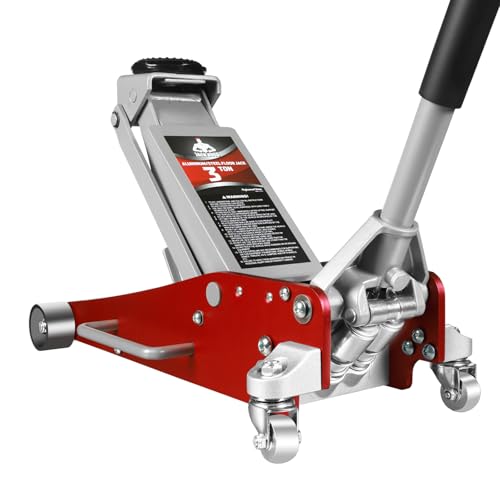
Specifications
| Color | Red |
|---|---|
| Size | 3 Ton Aluminum |
| Dimensions | 23.6 x 11.8 x 6.3 inches |
| Weight | 58.5 pounds |
| Product Group | Automotive Parts and Accessories |
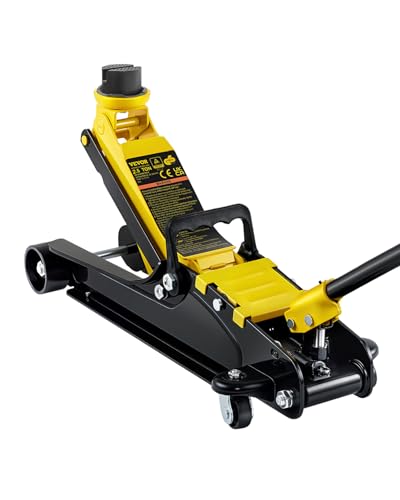
Specifications
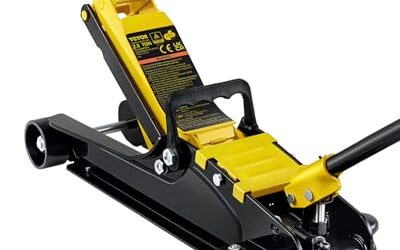
| Color | yellow |
|---|---|
| Size | 2.5T |
| Dimensions | 22.2 x 8.7 x 5.2 Inches |
| Weight | 29.982867632 pounds |
| Product Group | Automotive Parts and Accessories |
| Binding | Automotive |

Pros
- 3-ton capacity is specified for lifting SUVs and other supported vehicles
- Double locking system combines a handle-adjustment locking ratchet bar with metal safety pins
- Large base and top saddle are designed to provide stable support
- Ductile-iron ratchet bar is forged in one piece
- Product description states that the stands meet US safety standards
Cons
- The listing does not identify the exact vehicle models or weight limits beyond the 6,600-pound capacity
- Amazon rating and review count are inconsistent in the listing, listed as 4.5 from 0 reviews
Specifications
| Color | yellow |
|---|---|
| Size | 3 ton double locking and upgraded base |
| Dimensions | 8.59 x 14.5 x 8 Inches |
| Weight | 16.23043172844 Pounds |
| Product Group | Automotive Parts and Accessories |
| Binding | Automotive |
Best For / Avoid If
Best for buyers prioritizing
- 3-ton capacity is specified for lifting SUVs and other supported vehicles
- Double locking system combines a handle-adjustment locking ratchet bar with metal safety pins
- Large base and top saddle are designed to provide stable support
Consider another option if
- The listing does not identify the exact vehicle models or weight limits beyond the 6,600-pound capacity
- Amazon rating and review count are inconsistent in the listing, listed as 4.5 from 0 reviews
Frequently asked questions
Can I use the pinch weld as a lift point?
Only when instructions for your exact vehicle and task identify that location, and the jack or adapter fits as shown. Pinch-weld design and approved contact areas vary, so appearance alone is not enough.
Are factory jack locations the same as jack-stand locations?
Not necessarily. Use the vehicle’s instructions for each task. Do not assume that a point approved for raising the vehicle is also approved for supporting it.
Can I use a universal lift-point chart?
A generic chart cannot confirm fitment for every model year, body style, or powertrain. Use it only as a prompt to check vehicle-specific instructions, not as final approval.
What should I do if the owner’s manual has no lift diagram?
Check the vehicle-specific service procedure or ask a dealer or qualified repair shop. Do not choose a point by trial and error.
Sources and further reading
- Safety Standard for Portable Automotive Service Equipment (ASME): Learn about the scope of safety standards for portable automotive service equipment.