How to choose a jump starter as a gift starts with matching its voltage, engine size range, climate rating, and charging needs to the recipient’s vehicle. A useful gift must also fit the driver’s storage space and comfort level with connecting cables, because incorrect use can damage a vehicle or cause injury.
Key takeaways
- Most gas-powered passenger vehicles use 12-volt electrical systems, but confirm the vehicle manual before buying.
- Engine size ratings help compare models, but cold weather, battery condition, cable quality, and vehicle design also affect starting.
- Diesel engines, large trucks, boats, motorcycles, and commercial vehicles may need different capacity or connector features.
- Choose safety features such as reverse-polarity alerts, short-circuit protection, over-temperature protection, and an override function only when the manual explains its limits.
- USB ports, lights, air compressors, and wireless charging add uses but do not replace starting performance.
- A jump starter needs regular charging and safe storage. An unused unit can lose charge over time.
How to choose a jump starter as a gift
1. Start with recipient’s vehicle
Ask for vehicle year, make, model, engine type, and engine size. Model-year changes can affect battery location, terminal access, start-stop systems, and electrical requirements. A 2012 sedan and a newer version of the same model may not use the same battery layout or access points.
Most gasoline cars, crossovers, and light trucks use 12-volt starting systems. Many diesel vehicles also use 12 volts, but their larger engines can demand more starting power. Some heavy equipment and commercial vehicles use 24 volts. A 12-volt jump starter is not a safe substitute for a 24-volt unit.
Do not infer battery voltage from vehicle size alone. Check the owner’s manual, battery label, or a service document. Hybrid vehicles also need special care. A hybrid may use a 12-volt auxiliary battery, but its jump points and starting procedure can differ from those of a conventional vehicle. Follow the vehicle manual.
2. Match engine size and fuel type
Jump starter listings often show a maximum gasoline or diesel engine size. Treat those figures as a matching guide, not a promise that every weak battery will start. A deeply discharged battery, damaged cable, cold weather, or corroded connection can reduce available starting power.
Gasoline engines usually need less starting current than diesel engines of similar displacement. Diesel trucks may need a larger unit because compression is higher and glow-plug systems draw power. For a diesel pickup, check the jump starter’s diesel rating rather than using its gasoline rating.
For motorcycles, powersports vehicles, and lawn equipment, a compact unit may fit better. Some small units include connectors or modes for lower-capacity batteries. Never use a lithium jump starter on a battery type or voltage that its manual excludes.
3. Read peak current and starting current correctly
Peak amps describe a short burst under stated conditions. Starting or cranking current better reflects sustained output during an engine start. Listings do not always present these figures in the same way, so direct comparisons can mislead.
Higher numbers do not automatically make one unit right for every vehicle. The battery’s condition, temperature, cable resistance, and connection quality still matter. Choose a unit with a stated rating above the recipient’s vehicle needs, especially for diesel engines or winter use.
Cold weather reduces battery performance. Drivers in northern states may need more reserve than drivers in mild climates. A unit stored in a cold trunk may also deliver less power until it warms. The manual may state an operating temperature range. That range matters more than a large peak-amp number without context.
4. Check cable length, clamps, and connection access
Short cables can make a jump difficult when battery terminals sit deep in an engine bay or near a wheel well. Longer cables give more placement options, but they take more storage space. Look for cable length, clamp size, insulation, and connector design.
Small clamps may not grip large truck terminals well. Large clamps may be awkward on motorcycle batteries or remote jump points. A vehicle with a battery inside the cabin or under a seat may require separate jump terminals in the engine bay. The vehicle manual identifies the approved connection points.
Some newer jump starters use a detachable smart cable. The cable may include lights, an audible alert, or a display that shows connection status. These features can help a first-time user, but they do not replace correct terminal identification.
5. Prioritize safety features
Reverse-polarity protection warns when positive and negative connections are reversed. Short-circuit protection limits current during an unsafe connection. Over-temperature protection can stop operation if the unit or cables become too hot. These features reduce risk, but they do not make incorrect connections safe.
Some units include manual override or boost mode. This function may bypass part of the normal battery-detection process for a battery with extremely low voltage. It can also remove a safety check. Give this type of gift only when the recipient will read and follow the instructions.
Never connect positive and negative clamps together. Keep clamps away from moving belts, fans, hot exhaust parts, and fuel sources. Remove jewelry before working near a vehicle battery. Stop if the battery case is cracked, swollen, leaking, frozen, or producing a strong sulfur smell. A damaged battery needs service, not a jump attempt.
6. Decide which extra features matter
USB-A or USB-C ports can charge phones and other devices during an outage. Port output matters because a phone charger and a laptop charger have different power needs. USB-C does not always mean USB Power Delivery. Check the stated output if the recipient plans to charge a laptop or tablet.
An LED light helps with nighttime connections. A flashing emergency mode may help signal a disabled vehicle, but local traffic rules and road conditions still control safe roadside use.
Some jump starters include an air compressor. This can help add air to a tire, but it does not repair a puncture. Compressor speed, hose length, gauge accuracy, duty cycle, and tire-pressure limits affect usefulness. A unit with an air compressor is larger, so check whether the recipient has trunk or cargo space.
Wireless charging can reduce cable clutter for compatible phones. It requires a phone and case that support the same charging standard. It does not affect jump-start capability.
7. Check charging and storage needs
Most portable lithium jump starters charge from USB, a wall adapter, or a vehicle outlet. Confirm whether the package includes the charger and whether the recipient already owns a compatible power adapter. USB-C input can simplify charging, but input and output ratings may differ.
Storage instructions matter. Heat can damage lithium batteries, so a parked vehicle in direct summer sun may be a poor storage location unless the manual permits it. Extreme cold can reduce output. The recipient should inspect charge level at intervals and recharge the unit after use.
Look for a clear charge indicator and a manual that explains long-term storage. A jump starter is an emergency tool, not a set-and-forget accessory. If the recipient rarely drives, remind them to keep the unit charged outside the vehicle and place it in the vehicle before travel.
8. Match size to the gift recipient
A larger unit may offer more reserve and heavier cables, but it takes more room and weighs more. A compact model fits a glove box or motorcycle storage area but may not suit a diesel truck.
Ask where the recipient keeps roadside equipment. A sedan trunk, pickup toolbox, motorcycle pannier, and small crossover cargo area impose different limits. A unit that stays at home cannot help much during a roadside breakdown.
For related driver gifts, CarTechTalk also covers practical gifts for new car owners and compact car gifts under $25.
Quick gift decision guide
| Recipient vehicle or use | What to prioritize | What may rule out a choice |
|---|---|---|
| Gasoline sedan or crossover | 12-volt support, clear safety alerts, compact storage | Wrong voltage, poor clamp access, no charge indicator |
| Diesel pickup | Stated diesel rating, stronger cables, cold-weather reserve | Gasoline-only rating, small clamps, low operating-temperature range |
| Motorcycle or powersports vehicle | Small size, compatible battery mode, low-current connection guidance | Large clamps, unsupported battery type, excessive storage size |
| Hybrid vehicle | Vehicle-specific jump-point instructions, 12-volt compatibility | Assuming the high-voltage battery uses the same procedure |
| Frequent traveler | Long storage life, charge display, durable case, useful light | Unit requires frequent charging or cannot tolerate trunk temperatures |
| Driver with roadside emergencies | Simple controls, reverse-polarity alert, visible instructions | Complex override process or unclear cable sequence |
How to use a jump starter safely
- Park the disabled vehicle safely, switch off accessories, and set the parking brake.
- Read both vehicle and jump starter manuals before connecting anything.
- Confirm voltage and locate approved positive and negative jump points.
- Keep the jump starter switched off unless its instructions say otherwise.
- Connect the red clamp to the positive point and the black clamp to the approved negative point or ground point.
- Check the indicator for correct connection. Stop if the unit alerts you.
- Start the vehicle using short attempts. Follow the manual for wait times and maximum attempts.
- Switch off the jump starter before removing clamps, unless its instructions say another sequence.
- Remove clamps in the order stated by the manuals. Keep clamps from touching each other.
- Recharge the jump starter after use and inspect cables for heat or damage.
Some vehicles use a remote negative terminal instead of the battery’s negative post. Some battery systems require a specific ground point. The manual controls the connection method.
Common mistakes
- Buying by peak amps alone. Peak output does not reveal engine fit, cold-weather behavior, or cable quality.
- Assuming every vehicle uses 12 volts. Heavy trucks and equipment may use 24 volts.
- Ignoring diesel ratings. A gasoline engine-size claim may not apply to a diesel engine.
- Leaving the unit in a hot vehicle year-round. Lithium batteries can suffer from heat exposure.
- Using override mode as the normal start method. Override can remove safety checks.
- Trying to jump a damaged or frozen battery. Stop and seek service instead.
- Expecting a jump starter to fix a charging problem. If the alternator, battery, starter, or wiring has a fault, the vehicle may stop again.
- Confusing a jump starter with a battery charger. A jump starter supplies short-term starting power. A charger replenishes a battery over a longer period.
When to get professional help
Call roadside assistance or a technician when the battery is cracked, leaking, swollen, frozen, or hot. Get help when the vehicle has no approved jump points, uses a 24-volt system, or needs a procedure the owner’s manual does not explain.
Professional diagnosis also makes sense when the engine still will not crank after a correct connection, the cables become hot, electrical smells appear, or warning lights remain after starting. Repeated jump starts often point to a weak battery, charging-system fault, parasitic drain, starter problem, or poor cable connection.
A jump starter can restore enough power for one start. It cannot repair those faults or prove that the battery is healthy.
Gear that can help
If you need jump starters for this job, these picks already appear in our jump starters guides. Check the full guide for fit and who should skip each one.

Pros
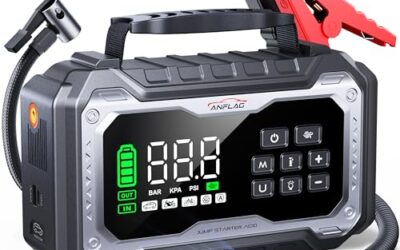
- Combines jump-starting, tire inflation, high-volume air movement, device charging, and emergency lighting in one unit
- Supports a wide stated range of vehicle applications, including gas engines and diesel engines up to 14.0L
- Includes automatic tire-pressure shut-off and five inflation presets
- Comes with jumper cables, an extended air hose, four air nozzles, a USB-A to USB-C cable, instructions, and a carrying case
Cons
- The unit weighs 4.85 lb
- The manufacturer recommends charging the device every 4-5 months if it remains idle
Specifications
| Color | Black |
|---|---|
| Dimensions | 9.1338582584 x 2.7952755877 x 5.4330708606 inches |
| Weight | 2.8439631798 pounds |
| Product Group | Automotive Parts and Accessories |
Best For / Avoid If
Best for buyers prioritizing
- Combines jump-starting, tire inflation, high-volume air movement, device charging, and emergency lighting in one unit
- Supports a wide stated range of vehicle applications, including gas engines and diesel engines up to 14.0L
- Includes automatic tire-pressure shut-off and five inflation presets
Consider another option if
- The unit weighs 4.85 lb
- The manufacturer recommends charging the device every 4-5 months if it remains idle

Pros
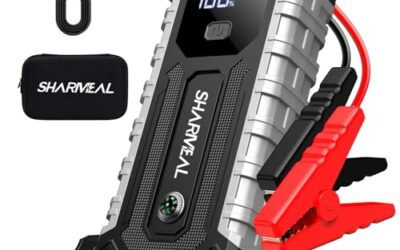
- Broad stated compatibility with gasoline and diesel engines up to 10.0L
- Provides USB, fast-charging USB, and USB Type-C charging options
- Includes multiple safety protection features and durable all-metal clamps
- Comes with a storage case and 18 months of warranty coverage
Cons
- A wall charger is not included
- The product is specified for compatible 12V vehicles
Specifications
| Color | yellow |
|---|---|
| Dimensions | 3.92 x 8.97 x 1.49 Inches |
| Weight | 3.94 pounds |
| Product Group | Automotive Parts and Accessories |
| Binding | Automotive |
Best For / Avoid If
Best for buyers prioritizing
- Broad stated compatibility with gasoline and diesel engines up to 10.0L
- Provides USB, fast-charging USB, and USB Type-C charging options
- Includes multiple safety protection features and durable all-metal clamps
Consider another option if
- A wall charger is not included
- The product is specified for compatible 12V vehicles

Pros
- Combines jump starting and cordless tire inflation in one portable unit
- Supports up to 150 PSI with automatic shut-off and selectable pressure units
- Includes five air nozzles and five inflation modes
- Provides stated support for more than 1,000 charge cycles
- Backed by an 18-month warranty
Cons
- The stated operating and storage temperature range is -4°F to 140°F, while charging is limited to 14°F to 113°F
- The unit should be recharged at least once every three months during long-term storage
Specifications
| Color | Red |
|---|---|
| Dimensions | 4.96 x 5.87 x 2.3 inches |
| Weight | 3.58 pounds |
| Product Group | Automotive Parts and Accessories |
Best For / Avoid If
Best for buyers prioritizing
- Combines jump starting and cordless tire inflation in one portable unit
- Supports up to 150 PSI with automatic shut-off and selectable pressure units
- Includes five air nozzles and five inflation modes
Consider another option if
- The stated operating and storage temperature range is -4°F to 140°F, while charging is limited to 14°F to 113°F
- The unit should be recharged at least once every three months during long-term storage
For a closer look at a related choice, see How To Connect A Jump Starter.
FAQ
What size jump starter should I gift for a car?
For a typical gasoline passenger car, choose a 12-volt unit with a stated gasoline engine range above the recipient’s engine size. Add more reserve for cold climates, older batteries, and frequent roadside use.
Can one jump starter work for cars and trucks?
Sometimes. Check both vehicle voltage and the jump starter’s gasoline or diesel rating. A unit suitable for a small car may not suit a large diesel truck, even when both use 12 volts.
Can a jump starter charge a dead car battery?
It can provide short-term power for starting. It does not replace a battery charger or repair a battery that cannot hold charge.
Should a jump starter stay in the car?
It can, if the manual permits vehicle storage conditions. Heat, freezing temperatures, and long periods without charging can reduce usefulness. Check charge level on a regular schedule.
Do hybrids need special jump starters?
Many hybrids use a 12-volt auxiliary battery, but jump points and procedures vary by model and model-year. Follow the vehicle manual rather than guessing from battery location.
Sources and further reading
- Battery Council International: Battery safety and battery-care information for vehicle owners.