Yes, you can use a jump starter on an AGM battery when the jump starter provides the vehicle’s correct voltage and the clamps connect with correct polarity. AGM batteries use different internal construction from flooded lead-acid batteries, but they still provide 12-volt starting power in most cars, trucks, and SUVs.
The jump starter supplies short-term current to help the starter motor turn. It does not repair a failed AGM battery, restore lost capacity, or replace proper charging. Check your vehicle manual and jump starter manual before connecting anything.
Key takeaways
- Most automotive AGM batteries work with 12-volt jump starters.
- AGM labeling does not mean you need a special jump starter.
- Correct polarity matters more than AGM branding.
- A jump pack may start an engine but cannot fix a damaged battery.
- Stop if the battery case is swollen, cracked, leaking, frozen, or hot.
- Hybrid and electric vehicles need model-specific procedures.
Why a jump starter works with an AGM battery
AGM means absorbed glass mat. Fiberglass mats hold battery electrolyte against the lead plates. This construction reduces free liquid movement and supports a sealed, low-maintenance battery format.
AGM batteries still use lead-acid chemistry. A standard automotive AGM battery normally operates in the same 12-volt vehicle system as many flooded batteries. A jump starter does not need to refill the battery. It adds enough current to support starter operation while the vehicle starts.
AGM batteries often appear in vehicles with stop-start systems, high electrical loads, luxury features, or batteries mounted in less accessible locations. Some vehicles use battery sensors, battery monitoring systems, or charging software that needs battery-type programming after replacement. That software does not usually prevent an emergency jump, but it can affect long-term charging and battery life.
Can you use any 12-volt jump starter on an AGM battery?
Usually, a 12-volt jump starter works with a 12-volt AGM battery. The pack still needs enough starting current for the engine, temperature, and battery condition. A small pack may help a compact gasoline engine but struggle with a large engine, diesel engine, extreme cold, or a deeply discharged battery.
Use a 24-volt setting only with a vehicle built for 24 volts. Connecting 24 volts to a 12-volt car can damage vehicle electronics, control modules, lamps, and battery components. Do not choose voltage based on AGM status. Choose it based on vehicle voltage.
| Situation | Jump starter choice | What it means |
|---|---|---|
| 12-volt passenger vehicle with AGM battery | 12-volt jump starter | Normal match for most cars and SUVs |
| Large gasoline engine | Higher-capacity 12-volt pack | More starting reserve helps during heavy cranking |
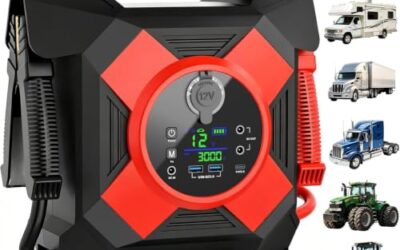
| Diesel truck | 12-volt pack rated for diesel use | Glow plugs and engine size can demand more current |
| 24-volt commercial vehicle | 24-volt equipment or approved 24-volt mode | Wrong voltage can damage electrical systems |
| Hybrid or electric vehicle | Vehicle-specific procedure | The 12-volt battery may power controls, contactors, or accessories |
How to use a jump starter on an AGM battery
Follow this sequence when the battery appears safe and the vehicle manual permits an external jump.
- Park safely. Set the parking brake, select Park or Neutral as required, and switch off lights, climate controls, audio, and accessories. Keep both vehicles or the jump pack away from moving traffic.
- Confirm voltage. Check that the vehicle and jump starter use the same voltage. Most cars use 12 volts. Do not guess with trucks, fleet vehicles, buses, or modified vehicles.
- Inspect the battery. Do not jump a swollen, cracked, leaking, frozen, smoking, or visibly damaged battery. A damaged battery can release gas or fail violently during charging or starting.
- Find approved connection points. Some vehicles place the battery in the trunk, under a seat, or behind panels. They may provide remote positive and negative terminals under the hood. Use the points named in the owner manual.
- Turn off the jump starter. Keep the pack off while connecting clamps unless its manual gives another procedure.
- Connect positive first. Attach the red clamp to the positive battery terminal or approved positive post. Avoid contact between the red clamp and body metal.
- Connect negative second. Attach the black clamp to the approved negative post or solid engine-ground point. Some vehicles prohibit direct connection to the negative battery terminal because of a battery sensor.
- Activate the pack. Turn on the jump starter or select its approved boost mode. Manual override modes can bypass protective checks. Use one only when the manual requires it and the clamps have correct polarity.
- Start the vehicle. Crank for the time stated in the jump starter instructions. If the engine does not start, stop and wait between attempts. Repeated long cranking can overheat the starter, cables, or pack.
- Remove clamps in reverse order. Switch off the pack when instructed. Remove the black clamp first, then the red clamp. Keep the clamps from touching each other or metal surfaces.
- Let the engine run only as the vehicle manual permits. Driving may recharge some battery capacity, but a short drive may not replace a deep discharge. A battery charger or shop test may be needed.
AGM battery safety limits
An AGM battery is sealed, not risk-free. Overcharging, short circuits, heat, and physical damage can create dangerous conditions. Keep sparks and open flames away from the battery area. Wear eye protection when working near any lead-acid battery.
Do not connect a jump starter to a battery with a frozen electrolyte condition. A deeply discharged battery can freeze at warmer temperatures than a fully charged battery. Thawing does not make a damaged battery safe. Do not heat it with a torch, heater, or other direct source.
Read the jump starter instructions for clamp placement, boost mode, maximum crank time, and reverse-polarity behavior. Pack features differ. Some devices refuse to activate when battery voltage is very low. Manual override may force output without the same protection.
What if the AGM battery will not accept a jump?
A jump starter may fail to start the vehicle for several reasons:
- Weak jump pack: The pack may lack current for engine size, cold weather, or a heavily discharged battery.
- Poor clamp contact: Corrosion, paint, dirt, or a loose terminal can block current.
- Wrong connection point: A remote terminal or battery sensor may require a specific procedure.
- Starter fault: A failed starter, relay, cable, or ground can prevent cranking even with strong battery support.
- Fuel or ignition fault: A normal crank does not prove the engine can run.
- Failed AGM battery: Internal plate damage or a shorted cell can stop the battery from holding power.
- Vehicle security lockout: Some vehicles need a key, fob, or reset procedure after low voltage.
Listen to the symptom. Rapid clicking often points to low voltage or poor connection. One heavy click can point to starter or cable trouble. Normal cranking with no start points away from the battery as the main fault.
Jump starter versus battery charger
A jump starter supplies short-term starting assistance. A charger supplies controlled current over time. Use a jump starter for an immediate start when the vehicle and battery are safe. Use an AGM-compatible charger to recharge a battery that has lost capacity but remains serviceable.
Choose an AGM setting on a charger only when the charger and vehicle battery require it. AGM charging voltage and control can differ from flooded-battery charging. Follow the battery label and vehicle manual. A charger cannot repair internal damage, severe sulfation, or a shorted cell.
For broader cold-weather and storage guidance, see CarTechTalk’s guide to jump starters for winter emergencies and jump starters for stored vehicles. Truck owners may need the higher-current guidance in the truck battery jump starter guide.
Common mistakes
- Using a 24-volt setting on a 12-volt vehicle.
- Reversing positive and negative clamps.
- Connecting to painted or corroded metal.
- Ignoring a swollen, cracked, leaking, or hot battery.
- Holding the starter engaged through repeated long attempts.
- Assuming the jump fixed a battery that repeatedly goes flat.
- Replacing an AGM battery without following vehicle battery-registration instructions.
- Using a lithium jump pack outside its temperature limits.
- Assuming every hybrid or EV follows the same 12-volt jump procedure.
When to get professional help
Stop and seek help when the battery shows physical damage, smells strongly of sulfur, becomes hot, sparks heavily, or causes smoke. Also stop when the vehicle has no approved connection points, the battery sits in a hard-to-reach location, or the owner manual forbids the proposed procedure.
Professional diagnosis makes sense after repeated jump needs, a no-start with strong cranking, warning lights after low voltage, or a battery that loses charge overnight. A technician can test battery health, alternator output, starter draw, parasitic drain, cables, grounds, and battery-monitoring systems.
Battery replacement may require registration or coding, depending on vehicle model and model year. The correct battery size, reserve capacity, terminal layout, and AGM specification also depend on the vehicle. Installing the wrong type can affect charging control and stop-start operation.
Gear that can help
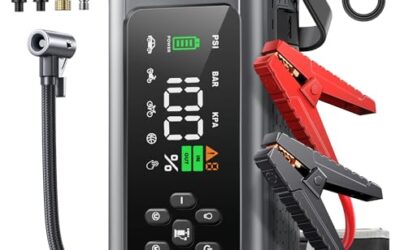
If you need jump starters for this job, these picks already appear in our jump starters guides. Check the full guide for fit and who should skip each one.

Pros
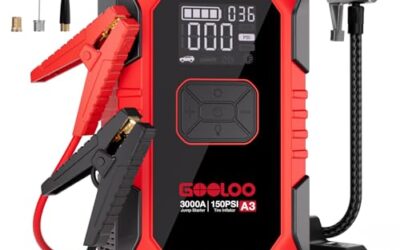
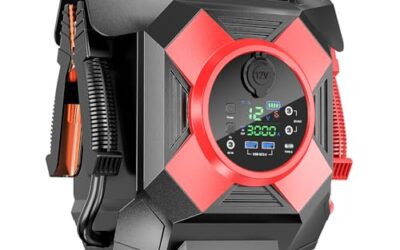
- Combines jump starting and cordless tire inflation in one portable unit
- Supports up to 150 PSI with automatic shut-off and selectable pressure units
- Includes five air nozzles and five inflation modes
- Provides stated support for more than 1,000 charge cycles
- Backed by an 18-month warranty
Cons
- The stated operating and storage temperature range is -4°F to 140°F, while charging is limited to 14°F to 113°F
- The unit should be recharged at least once every three months during long-term storage
Specifications
| Color | Red |
|---|---|
| Dimensions | 4.96 x 5.87 x 2.3 inches |
| Weight | 3.58 pounds |
| Product Group | Automotive Parts and Accessories |
Best For / Avoid If
Best for buyers prioritizing
- Combines jump starting and cordless tire inflation in one portable unit
- Supports up to 150 PSI with automatic shut-off and selectable pressure units
- Includes five air nozzles and five inflation modes
Consider another option if
- The stated operating and storage temperature range is -4°F to 140°F, while charging is limited to 14°F to 113°F
- The unit should be recharged at least once every three months during long-term storage

Pros
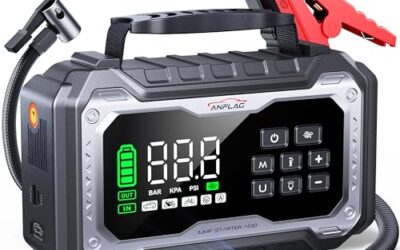
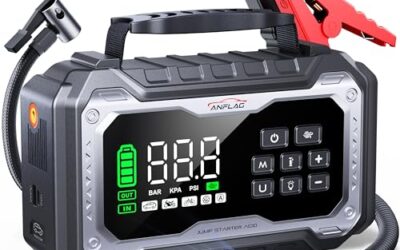
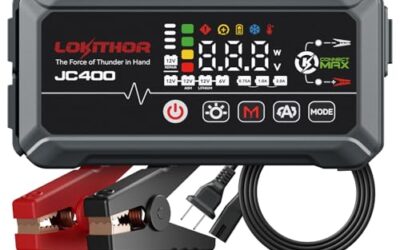
- High 1000-amp peak rating for a compact 2.5-pound jump starter
- Stated compatibility with 12V vehicles and engines up to 6.0L gas or 3.0L diesel
- Built-in spark-proof and reverse-polarity protection
- Adds power-bank and flashlight functionality for emergency use
Cons
- The stated engine compatibility is limited to up to 6.0L gas and 3.0L diesel
- The listed warranty period is one year
Specifications
| Color | Gray |
|---|---|
| Size | 1000 Amps |
| Dimensions | 6.5748031429 x 3.149606296 x 7.7165354252 Inches |
| Weight | 2.4 Pounds |
| Product Group | Automotive Parts and Accessories |
| Binding | Automotive |
Best For / Avoid If
Best for buyers prioritizing
- High 1000-amp peak rating for a compact 2.5-pound jump starter
- Stated compatibility with 12V vehicles and engines up to 6.0L gas or 3.0L diesel
- Built-in spark-proof and reverse-polarity protection
Consider another option if
- The stated engine compatibility is limited to up to 6.0L gas and 3.0L diesel
- The listed warranty period is one year
FAQ
Can an AGM battery damage a jump starter?
A healthy AGM battery should not damage a correctly matched jump starter. Reverse polarity, short circuits, wrong voltage, damaged batteries, and improper boost-mode use create the main risks.
Can you jump-start an AGM battery with a regular battery pack?
Yes, if the pack supports the vehicle’s voltage and has enough starting capacity. AGM status alone does not require a special jump pack.
Should you charge an AGM battery after jump-starting?
Usually, yes. A jump starts the engine but may leave the battery deeply discharged. Use an AGM-compatible charger or have the charging system and battery tested.
Can you jump-start a stop-start vehicle with an AGM battery?
Often, yes. Use the vehicle’s listed jump points and follow its battery-monitoring instructions. Some stop-start systems use special connection rules.
Can you jump-start a hybrid or electric vehicle?
Many hybrids and EVs have a separate 12-volt battery, but procedures vary by model and model year. Never treat the high-voltage battery pack as a normal jump-start connection.
Sources and further reading
- Battery Council International: Battery safety and lead-acid battery information.