The Quick Answer
For testing household batteries under a documented electrical load, the KKEANIC household battery tester is the most practical choice from this comparison. The manufacturer specifies load resistors for common cylindrical cells, rechargeable cells, selected button cells, CR2/CR123A batteries, and 9V batteries. It also displays measured voltage and a Good, Weak, or Poor indicator.
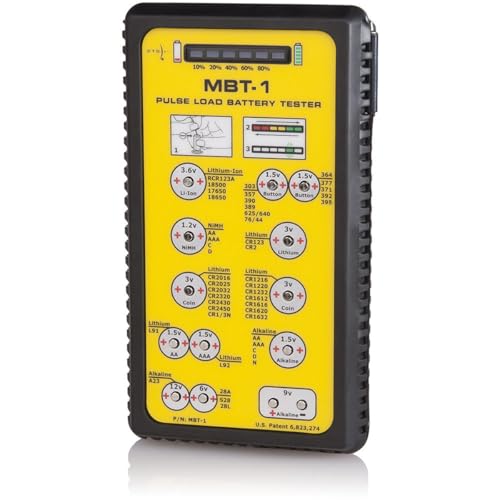
The ZTS Multi-Battery Tester is the premium alternative. ZTS lists a patented pulse-load test and positions it for identifying weak batteries and matching cells. Confirm compatibility with every battery type you intend to test before paying its substantially higher listed price.
The ten-product source list also includes basic household voltage checkers and automotive starting-battery analyzers. Those can serve other purposes, but they are not recommendations for this specific search because their the listing do not document an appropriate load test for household batteries.
CarTechTalk may earn a commission from qualifying purchases made through product links. This does not change the specifications considered or the conditional recommendations below. Prices were observed when the product data was provided, can change, and should be confirmed before purchase.

Pros
- Supports multiple common battery sizes and types
- Includes separate voltage ranges for alkaline, rechargeable, and lithium button cell batteries
- Provides voltage and strength indications through an LED display
- Uses a three-step operating process
Cons
- The battery must be removed after testing
Specifications
| Color | Black |
|---|---|
| Size | Compact |
| Dimensions | 3.53 x 1 x 0.98 inches |
| Product Group | Automotive Parts and Accessories |
| Binding | Unknown Binding |
Best For / Avoid If
Best for buyers prioritizing
- Supports multiple common battery sizes and types
- Includes separate voltage ranges for alkaline, rechargeable, and lithium button cell batteries
- Provides voltage and strength indications through an LED display
Consider another option if
- The battery must be removed after testing

Pros
- Covers multiple household, button-cell, and 1.2V rechargeable battery formats
- Displays both voltage and a colored power-level indicator
- Lists stated accuracy of ±(1% of reading + 0.02V)
- Includes a low-power warning indicator and approximately one year of standby time when powered by AAA batteries
Cons
- Lithium battery testing is not supported
- Requires one AAA battery, which is not included
- The screen is not backlit, and no battery storage case is provided
Specifications
| Color | black-black |
|---|---|
| Size | 2.87 x 4.69 x 1 inches |
| Dimensions | 4.69 x 2.87 x 1 inches |
| Weight | 0.22 pounds |
| Product Group | BISS |
Best For / Avoid If
Best for buyers prioritizing
- Covers multiple household, button-cell, and 1.2V rechargeable battery formats
- Displays both voltage and a colored power-level indicator
- Lists stated accuracy of ±(1% of reading + 0.02V)
Consider another option if
- Lithium battery testing is not supported
- Requires one AAA battery, which is not included
- The screen is not backlit, and no battery storage case is provided

Pros
- Covers several common household battery types
- Magnetic tip is designed to provide stable battery contact
- Analog display is described as easy to read
- Compact design supports convenient storage and portability
Specifications
| Color | Black |
|---|---|
| Size | Small |
| Dimensions | 4.33 x 2.32 x 0.98 inches |
| Product Group | BISS |
Best For / Avoid If
Best for buyers prioritizing
- Covers several common household battery types
- Magnetic tip is designed to provide stable battery contact
- Analog display is described as easy to read

Pros
- Covers several common household battery types
- Simple status display with green, yellow, and red zones
- Does not require a separate power source
Cons
- Tests battery voltage and does not directly measure capacity precisely
- Test times should be kept short to avoid unnecessary battery drain
Specifications
| Color | 2Pcs |
|---|---|
| Dimensions | 4.13 x 1.57 x 0.78 Inches |
| Weight | 0.000625 pounds |
| Product Group | BISS |
| Binding | Misc. |
Best For / Avoid If
Best for buyers prioritizing
- Covers several common household battery types
- Simple status display with green, yellow, and red zones
- Does not require a separate power source
Consider another option if
- Tests battery voltage and does not directly measure capacity precisely
- Test times should be kept short to avoid unnecessary battery drain
Pros
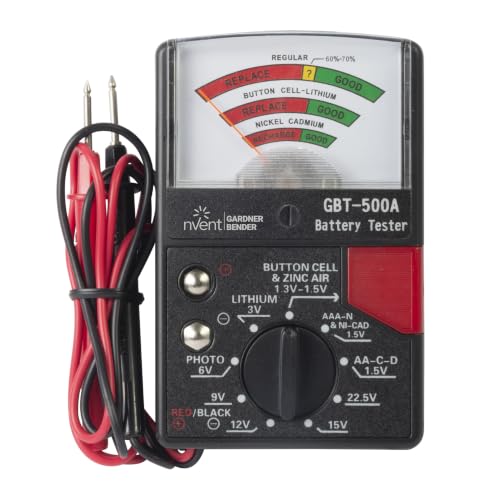
- Includes test leads
- Covers several common household and specialty battery types
- Uses an analog testing format
Cons
- The additional battery types represented by "& More" are not identified
Specifications
| Color | Black |
|---|---|
| Size | No Size |
| Dimensions | 1.5 x 2.5 x 3.8 Inches |
| Weight | 0.22 pounds |
| Product Group | Home Improvement |
| Binding | Tools & Home Improvement |
Best For / Avoid If
Best for buyers prioritizing
- Includes test leads
- Covers several common household and specialty battery types
- Uses an analog testing format
Consider another option if
- The additional battery types represented by "& More" are not identified

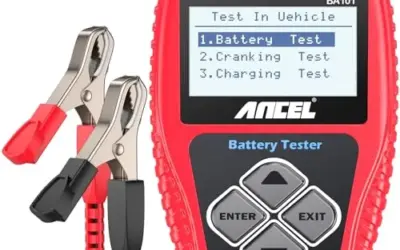
Pros
- Covers several common 12V lead-acid battery types
- Combines battery, cranking, and charging-system testing
- Compact design can be stored in a glove box or center console
- Does not require charging the tester before use
Cons
- Limited to 12V batteries
- The listing does not list detailed specifications beyond the stated battery compatibility and testing functions
- The tester powers on only after it is properly attached to a battery
Best For / Avoid If
Best for buyers prioritizing
- Covers several common 12V lead-acid battery types
- Combines battery, cranking, and charging-system testing
- Compact design can be stored in a glove box or center console
Consider another option if
- Limited to 12V batteries
- The listing does not list detailed specifications beyond the stated battery compatibility and testing functions
- The tester powers on only after it is properly attached to a battery

Pros
- Covers cars, motorcycles, trucks, SUVs, boats, ATVs, and lawnmowers
- Supports CCA, JIS, EN, DIN, SAE, IEC, and GB testing standards
- Identifies battery, starter, and alternator-related conditions through separate test functions
- Runs directly from the battery under test without requiring internal batteries
Cons
- The device is powered by the battery under test and does not have an internal battery
- Free software updates are specified for use through a Windows PC
Specifications
| Color | Red |
|---|---|
| Dimensions | 6.46 x 0.94 x 3.39 inches |
| Weight | 0.604375 Pounds |
| Product Group | BISS |
Best For / Avoid If
Best for buyers prioritizing
- Covers cars, motorcycles, trucks, SUVs, boats, ATVs, and lawnmowers
- Supports CCA, JIS, EN, DIN, SAE, IEC, and GB testing standards
- Identifies battery, starter, and alternator-related conditions through separate test functions
Consider another option if
- The device is powered by the battery under test and does not have an internal battery
- Free software updates are specified for use through a Windows PC

Pros
- Supports several common household battery sizes
- Does not require charging or a separate power source
- Digital 18-level display provides more detailed power indications than a simple analog dial
- ABS outer shell and non-slip grips are specified for everyday use
Cons
- Batteries are not included
Specifications
| Color | Black |
|---|---|
| Size | 1 Pack |
| Dimensions | 3.7401574765 x 1.55511810865 x 0.7480314953 inches |
| Weight | 0.07054792384 Pounds |
| Product Group | BISS |
Best For / Avoid If
Best for buyers prioritizing
- Supports several common household battery sizes
- Does not require charging or a separate power source
- Digital 18-level display provides more detailed power indications than a simple analog dial
Consider another option if
- Batteries are not included
Pros
- Simple operation without switches or settings
- Pulse Load Test is specified as high accuracy and patented
- Supports battery management and cell matching applications
Cons
- The source lists different size information: 7.5x4x1.25 and 4.5 x 1.25 x 8 inches
Best For / Avoid If
Best for buyers prioritizing
- Simple operation without switches or settings
- Pulse Load Test is specified as high accuracy and patented
- Supports battery management and cell matching applications
Consider another option if
- The source lists different size information: 7.5x4x1.25 and 4.5 x 1.25 x 8 inches

Pros
- Broad compatibility across household, button-cell, lithium, and alkaline batteries
- Provides both voltage and battery-level information on an LCD screen
- Compact listed dimensions of 6.1 x 3.6 x 0.9 inches and listed weight of 0.3 pounds
- Includes a self-test function when the check button is held for 3 seconds
Cons
- The tester must be powered by 1.5V AAA alkaline batteries
- The check button must be held for 3 seconds to run a self-test; otherwise, the display shows "Err"
Specifications
| Color | Black |
|---|---|
| Dimensions | 6.1 x 3.6 x 0.9 inches |
| Weight | 0.3 pounds |
| Product Group | BISS |
Best For / Avoid If
Best for buyers prioritizing
- Broad compatibility across household, button-cell, lithium, and alkaline batteries
- Provides both voltage and battery-level information on an LCD screen
- Compact listed dimensions of 6.1 x 3.6 x 0.9 inches and listed weight of 0.3 pounds
Consider another option if
- The tester must be powered by 1.5V AAA alkaline batteries
- The check button must be held for 3 seconds to run a self-test; otherwise, the display shows "Err"
What to Look For in Battery Chargers & Testers
This guide is an editorial comparison of the published manufacturer-listed specifications, compatibility details, power requirements, test methods, limitations, and observed prices. CarTechTalk did not perform laboratory measurements or first-hand evaluation for this article.
Because the search intent specifically calls for a battery tester that checks household batteries under load, documenting a load-test method was the threshold requirement for a recommendation. A basic tester may show battery voltage, but voltage by itself does not establish how well a cell will hold up once a device draws current.
Only two products in the included set explicitly document load testing suitable for this intent: KKEANIC specifies fixed discharge resistors for several household battery groups, while ZTS lists a pulse-load test. Products described only as voltage checkers or general battery testers were not promoted to recommendations. The two automotive analyzers were also excluded because they are intended for vehicle starting batteries rather than AA, AAA, C, D, 9V, or button cells.
Sizing, Fitment, and Setup Notes
Match Both Size and Chemistry
Physical fit is not enough. An AA alkaline cell is nominally 1.5V, while an AA nickel-metal hydride rechargeable cell is nominally 1.2V and follows a different discharge curve. Coin cells and cylindrical lithium cells can also require different loads and interpretation thresholds. Choose a tester that explicitly supports the cell’s chemistry, voltage, and form factor.
The KKEANIC model provides the broader documented size list, but its contradictory lithium wording deserves caution. ZTS may support a useful range, yet that range is not present in the listed evidence. Do not assume compatibility from the phrase “multi-battery.”
Household Testers Are Not Car-Battery Load Testers
A household tester designed around milliamp-level loads is not appropriate for evaluating a vehicle starting battery. Conversely, an analyzer intended for 6V, 12V, or 24V starting systems is not a substitute for an AA or coin-cell checker. Vehicle analyzers use battery standards, cold-cranking-amp ratings, clamps, and starting or charging-system diagnostics that do not apply to loose household cells.
Use Results as Sorting Guidance
A tester’s Good, Weak, or Poor result is based on its internal thresholds and test load. It does not calculate exact remaining runtime in your device. A battery marked weak may still operate a low-drain wall clock or remote but fail in a motorized toy, camera flash, or high-output flashlight.
For multi-cell devices, test every cell individually and avoid mixing old and new cells. Also avoid combining different chemistries or capacities unless the device manufacturer explicitly permits it. One weak cell can limit an otherwise functional set, while mismatched cells can discharge unevenly.
Narrowing Down a Household Battery Tester Under Load
- Start with your battery inventory. List the sizes, nominal voltages, and chemistries you actually own. Include less common formats such as N, AAAA, CR123A, or coin cells.
- Look for a documented load. A resistor value, approximate test current, or defined pulse-load system is better evidence for this use case than a generic “battery health” claim.
- Consider the output. A voltage reading provides more detail, while a color band or status label is faster for sorting. Neither predicts exact runtime without device-specific context.
- Check operating power. Self-powered testers are convenient, but their test time should be kept short. Internally powered digital models can offer clearer displays while adding another battery to maintain.
- Review activation limits. An internally powered tester may still require a minimum cell voltage to detect a battery. This can affect diagnosis of severely depleted cells.
- Confirm the current price. The prices in this guide are observed figures rather than permanent price ceilings. Compare current listings before deciding whether additional compatibility or a pulse-load design justifies the cost.
Questions Buyers Ask
What does testing a battery under load mean?
It means the tester connects an electrical load while measuring the battery’s response. This can reveal voltage sag that may not appear in an unloaded reading. The usefulness of the result still depends on the applied load and the tester’s interpretation thresholds.
Is a voltage-only battery tester useless?
No. It can quickly identify reversed placement, a nearly dead cell, or major voltage differences within a set. Its limitation is that an unloaded voltage can look acceptable even when a battery struggles to supply current. For the search intent addressed here, a documented load test is the more relevant feature.
Can a tester tell me the exact remaining battery capacity?
Not from a quick load test alone. Exact capacity evaluation generally requires a controlled discharge over time with chemistry-appropriate cutoff criteria. The products here should be treated as sorting and diagnostic tools, not laboratory capacity analyzers.
Can I test rechargeable household batteries?
The KKEANIC manufacturer explicitly lists a 30-ohm load for 1.2V rechargeable batteries and names rechargeable AA, AAA, and AAAA support. Rechargeable compatibility for the ZTS model is not listed, so it should be confirmed before purchase.
How long should I leave a battery in a tester?
Follow the product instructions and keep the test no longer than necessary to obtain a stable result. A load test draws energy from the battery, even if the amount used during a brief check is small. Remove cells after testing and inspect them for leakage, swelling, corrosion, or physical damage before further use.
Before you buy, it is worth reading Best Battery Tester For Household Batteries, Battery Tester Buying Guide for Beginners and Best Battery Tester for Small Batteries With Load.
Final Recommendation
The KKEANIC household battery tester is the clearest recommendation for buyers seeking the best battery tester under load for household batteries. Its manufacturer provides actual resistor values, approximate test currents, broad size compatibility, a numerical voltage display, and status guidance. Its need for a separate AAA battery, lack of backlighting, 0.7V activation threshold, and contradictory lithium language prevent it from being an unconditional choice.
Choose the ZTS Multi-Battery Tester if you specifically value a simple pulse-load system and are comfortable paying more, but verify supported sizes, chemistries, and output behavior first. For either model, treat the result as a practical battery-sorting tool rather than a guarantee of remaining runtime or device performance.