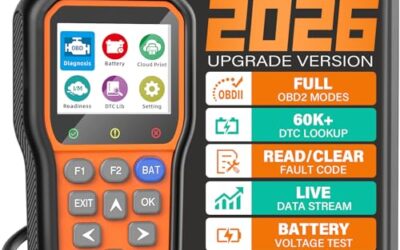
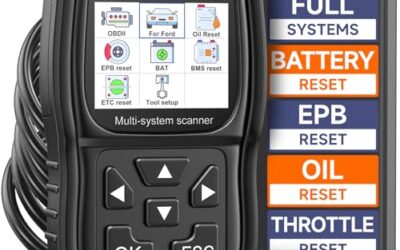
Ancel AD310 vs AD410 comes down to a simple choice: the AD410 fits most drivers better because its color screen, built-in code definitions, and extra OBD2 functions reduce guesswork. The AD310 remains a sensible budget pick for drivers who only need basic engine and emissions code reading, clearing, and live data.

Pros
- Supports multiple common OBDII protocols, including CAN
- Provides more than basic code reading with live data, freeze-frame, and readiness information
- Powered through the vehicle, so no separate battery or charger is required
- Compact design and 12-ounce weight support portability
Cons
- Limited to emission-related diagnostics
- Requires a vehicle with an OBDII interface and does not diagnose OBDI vehicles, even with an adapter
- Vehicle compatibility should be confirmed before purchase
Specifications
| Color | Black |
|---|---|
| Dimensions | 4.9212598375 x 2.755905509 x 0.8661417314 inches |
| Product Group | Automotive Parts and Accessories |
| Binding | Automotive |
Best For / Avoid If
Best for buyers prioritizing
- Supports multiple common OBDII protocols, including CAN
- Provides more than basic code reading with live data, freeze-frame, and readiness information
- Powered through the vehicle, so no separate battery or charger is required
Consider another option if
- Limited to emission-related diagnostics
- Requires a vehicle with an OBDII interface and does not diagnose OBDI vehicles, even with an adapter
- Vehicle compatibility should be confirmed before purchase

Pros
- Broad basic OBD2 diagnostic function set
- Built-in code definitions can help explain fault codes
- Supports major protocols including CAN, ISO9141, KWP2000, J1850 VPW and J1850 PWM
- Color display, multilingual support and on-screen code definitions
Cons
- Limited to engine and emission-related codes
- Does not support ABS, SRS, transmission, bidirectional control or service reset functions
- Vehicle compatibility should be checked before purchase
Specifications
| Color | yellow |
|---|---|
| Dimensions | 9 x 6.3 x 1.6 inches |
| Weight | 0.66 Pounds |
| Product Group | Automotive Parts and Accessories |
| Binding | Automotive |
Best For / Avoid If
Best for buyers prioritizing
- Broad basic OBD2 diagnostic function set
- Built-in code definitions can help explain fault codes
- Supports major protocols including CAN, ISO9141, KWP2000, J1850 VPW and J1850 PWM
Consider another option if
- Limited to engine and emission-related codes
- Does not support ABS, SRS, transmission, bidirectional control or service reset functions
- Vehicle compatibility should be checked before purchase
Both scanners connect directly to a vehicle’s 16-pin OBD2 port. Both draw power from that port, so neither needs batteries, a charger, Bluetooth, or a phone app. Their main job is engine and emissions diagnosis, not full vehicle service work.
The AD310 uses a compact black design with a 2.5-foot cable and a screen for scan results. The AD410 adds a 2.4-inch color display, multilingual support, and more than 42,000 built-in DTC definitions according to its listing. That difference matters most for new DIY users who want code explanations on the vehicle instead of searching each code separately.
| Feature | ANCEL AD310 Classic Enhanced Universal OBD II | ANCEL AD410 Enhanced OBD2 Scanner |
|---|---|---|
| Primary use | Engine and emissions fault codes | Engine and emissions fault codes |
| Vehicle coverage | Most 1996 and newer US OBD2 vehicles, plus many 2000 and newer EU and Asian vehicles | Most 1996 and newer US OBD2 vehicles, plus many 2000 and newer EU and Asian vehicles |
| Supported protocols | CAN, KWP2000, ISO9141, J1850 VPW, J1850 PWM | CAN, KWP2000, ISO9141, J1850 VPW, J1850 PWM |
| Power | Vehicle OBD2 port | Vehicle OBD2 port |
| Display | Screen with labeled buttons | 2.4-inch color display |
| Built-in code definitions | Not included among listed features | More than 42,000 DTC lookups |
| Live data | Yes | Yes |
| Freeze frame | Yes | Yes |
| I/M readiness | Yes | Yes |
| O2 sensor function | Not included among listed features | Yes |
| EVAP function | Not included among listed features | Yes |
| ABS, SRS, transmission, bidirectional, and service reset functions | Not supported | Not supported |
CarTechTalk may earn a commission from qualifying purchases. That does not change the fit-based recommendations below.
Why the AD410 is the better choice for most drivers
The AD410 earns the stronger general recommendation because it gives beginners more information at the car. Its built-in DTC lookup database can show code definitions without a second device. That does not turn a fault code into a complete diagnosis, but it makes the first step clearer.
Its extra functions also give the owner more ways to investigate an emissions problem. The listing includes live engine data such as RPM, coolant temperature, fuel trim, and oxygen sensor readings when those parameters are available from the vehicle. These values can help an informed owner discuss symptoms with a repair shop or spot changes after a repair.
The I/M readiness screen has a practical use before an emissions inspection. It shows whether required monitors are ready after repairs or after diagnostic codes have been cleared. Clearing codes can reset readiness monitors, so a driver should not erase a light immediately before an inspection and expect the vehicle to be ready.
The AD410 also lists O2 sensor and EVAP functions. Those tools remain limited to the information and controls exposed through standard OBD2, but they give emissions-focused DIY work more coverage than a basic code reader.
Best for: first-time DIY diagnosis
Choose the AD410 if you want on-screen code definitions, color menus, live data, readiness status, and added emissions functions in one corded tool. It suits a driver who wants to understand a check engine light before deciding whether to keep driving, inspect a simple issue, or call a mechanic.
Skip the AD410 if your goal is only to read and clear occasional engine codes at the lowest purchase tier. Its added functions will have little value if you never use live data, readiness information, O2 sensor functions, or EVAP functions.
Where the AD310 still makes sense
The AD310 focuses on the core job. It reads and clears emission-related trouble codes, shows live data and freeze frame information, checks I/M readiness, and displays vehicle information. For a driver who wants a compact glove-box reader, that may cover the need.
Freeze frame data can show vehicle conditions captured when a fault occurred. That context may include engine operating information available through the car’s OBD2 system. It can help a mechanic understand whether a warning appeared during a cold start, steady driving, or another recorded condition.
The AD310 has a 2.5-foot cable. Extra reach can make it easier to hold the reader while viewing the port area or place the unit where its screen remains visible. The listing gives its weight as 12 ounces and its dimensions as 8.9 by 6.9 by 1.4 inches. Those figures support storage in a vehicle bag, though the reader still needs to remain clear of pedals and steering controls during use.
Its protocol coverage includes CAN, KWP2000, ISO9141, J1850 VPW, and J1850 PWM. Those protocols support broad OBD2 coverage across many US, EU, and Asian vehicles, but protocol support does not make every vehicle compatible. The car still needs a compatible OBD2 interface and a supported emissions system.
Best for: low-cost code reading
Choose the AD310 if you need a straightforward engine code reader for a 1996 or newer US OBD2 vehicle, or many 2000 and newer EU or Asian vehicles. It fits owners who can look up codes separately and want basic information before visiting a repair shop.
Skip the AD310 if built-in code explanations, O2 sensor functions, EVAP functions, or richer on-screen guidance matter to you. Its documented scope is also limited to emission-related issues, so it cannot serve as a general scanner for every warning light.
Compatibility matters more than the model number
Both scanners target standard OBD2 vehicles. The AD310 listing points to 1996 and newer US vehicles, plus 2000 and newer EU and Asian vehicles. The AD410 uses similar coverage language. These dates describe broad market requirements, not a guarantee for every trim, engine, import, or regional model.
Neither scanner supports an OBDI interface. An adapter cannot turn an OBDI vehicle into a supported OBD2 vehicle, according to the AD310 listing. Older vehicles may need a different diagnostic tool and connector.
Connector access also matters. The vehicle must have a working 16-pin OBD2 data link connector, and the ignition must be switched on for scanning. Since each unit draws power from the vehicle port, a dead vehicle battery or a port power problem can prevent normal use.
Compatibility ends at standard engine and emissions diagnosis. The AD410 listing specifically excludes ABS, SRS, transmission, bidirectional control, and service reset functions. The AD310 is also not a full-system scanner. A vehicle with an airbag, brake, transmission, or maintenance warning may need a tool with the correct manufacturer or system coverage.
What live data can and cannot tell you
Live data gives current readings, not a final repair answer. The AD410 can display values such as RPM, coolant temperature, fuel trim, and oxygen sensor readings when the vehicle makes them available. A reading outside a normal range may point toward a fault, but the correct interpretation depends on engine design, temperature, operating state, and related codes.
The AD310 also lists live data. Its value is strongest when paired with a clear symptom and a known code. For example, a driver can record the code, review freeze frame information, and share those details with a mechanic. Neither scanner replaces a wiring inspection, pressure check, vacuum check, component test, or service manual procedure.
Code clearing deserves care. Erasing a code turns off the malfunction indicator lamp in some situations, but it does not repair the cause. It can also clear useful freeze frame information and reset emissions readiness monitors. Read the code first, save the information, repair the cause, then clear the code when appropriate.
Which scanner should you buy?
Buy the AD410 when information saves you time
The AD410 makes more sense for a household vehicle, a new DIY owner, or anyone who wants code definitions on the display. Its color screen and built-in lookup database reduce the need to carry a phone while working near the diagnostic port. Readiness, O2 sensor, EVAP, and live data functions also support more detailed emissions troubleshooting.
The tradeoff is simple: you pay for features that may remain unused. The scanner still cannot read ABS or SRS codes, reset service intervals, control vehicle systems, or perform bidirectional commands. Owners seeking those functions should move to a professional automotive diagnostic scanner, such as the tools discussed in this guide for technicians.
Buy the AD310 when simplicity matters most
The AD310 fits a driver who wants a compact corded reader for engine and emissions faults. It covers the core OBD2 tasks, includes live data and freeze frame, and supports I/M readiness. Its lower position in the range makes sense when the scanner will stay in a glove box and come out only for a check engine light.
The tradeoff is less guidance and narrower listed function coverage. Owners must look up code meanings separately, and the scanner cannot address non-emissions systems. If live readings are central to your repair work, compare this basic category with a live data scan tool guide before buying.
Who should buy neither scanner?
Buy neither if you need ABS, airbag, transmission, service reset, bidirectional control, or manufacturer-specific functions. These scanners are not substitutes for a full-system diagnostic platform. A shop technician, advanced DIY mechanic, or owner chasing several warning systems should look for a scanner that names those functions for the exact vehicle.
Also skip both if the vehicle uses an OBDI interface or falls outside the stated model-year and regional coverage. An adapter alone does not establish compatibility. A vehicle service manual or manufacturer fitment source remains the right place to identify the required diagnostic connection and system coverage.
Final verdict: AD310 vs AD410
The ANCEL AD410 is the better pick for most drivers comparing these two scanners. Built-in DTC definitions, a color display, live data, readiness information, O2 sensor functions, and EVAP functions give it more useful information for routine check engine light work.
The ANCEL AD310 wins on focused simplicity. Choose it when basic engine and emissions code reading, clearing, live data, freeze frame, and I/M readiness meet your needs. Choose the AD410 when you want more guidance and more emissions-related functions without moving to a phone-based tool.
Neither model is the right answer for full vehicle diagnosis. Match the scanner to the warning system, connector, model year, region, and repair task before purchase. For broader home-garage options, see CarTechTalk’s OBD2 scanner guide for home mechanics and drivers.