Foxwell NT301 vs Ancel AD410 favors the ANCEL AD410 Enhanced OBD2 Scanner for most drivers because it costs less, includes built-in definitions for more than 42,000 diagnostic trouble codes, and covers core engine and emissions functions. The FOXWELL NT301 OBD2 Scanner Live Data suits buyers who want a larger screen, dedicated readiness controls, graphing, and a stated lifetime update benefit.

Pros
- Includes live-data graphing and logging for supported OBD2 vehicles
- Offers emissions-readiness, O-2 sensor, and EVAP monitoring functions
- Supports common OBD2 protocols and many 1996-plus US gasoline vehicles
- Does not require a separate charging setup
Cons
- Does not scan ABS, SRS, EPB, A/C, battery, or other non-engine systems
- Compatibility and available functions vary by vehicle year, make, model, and VIN
Specifications
| Color | NT301 OBD2 Scanner |
|---|---|
| Size | NT301 Code Reader |
| Dimensions | 8.66 x 3.15 x 6.69 inches |
| Weight | 0.3527396192 Pounds |
| Product Group | Automotive Parts and Accessories |
| Binding | Automotive |
Best For / Avoid If
Best for buyers prioritizing
- Includes live-data graphing and logging for supported OBD2 vehicles
- Offers emissions-readiness, O-2 sensor, and EVAP monitoring functions
- Supports common OBD2 protocols and many 1996-plus US gasoline vehicles
Consider another option if
- Does not scan ABS, SRS, EPB, A/C, battery, or other non-engine systems
- Compatibility and available functions vary by vehicle year, make, model, and VIN

Pros
- Broad basic OBD2 diagnostic function set
- Built-in code definitions can help explain fault codes
- Supports major protocols including CAN, ISO9141, KWP2000, J1850 VPW and J1850 PWM
- Color display, multilingual support and on-screen code definitions
Cons
- Limited to engine and emission-related codes
- Does not support ABS, SRS, transmission, bidirectional control or service reset functions
- Vehicle compatibility should be checked before purchase
Specifications
| Color | yellow |
|---|---|
| Dimensions | 9 x 6.3 x 1.6 inches |
| Weight | 0.66 Pounds |
| Product Group | Automotive Parts and Accessories |
| Binding | Automotive |
Best For / Avoid If
Best for buyers prioritizing
- Broad basic OBD2 diagnostic function set
- Built-in code definitions can help explain fault codes
- Supports major protocols including CAN, ISO9141, KWP2000, J1850 VPW and J1850 PWM
Consider another option if
- Limited to engine and emission-related codes
- Does not support ABS, SRS, transmission, bidirectional control or service reset functions
- Vehicle compatibility should be checked before purchase
Both scanners target the same problem: an illuminated check engine light on an OBD2-equipped vehicle. Neither product is a full vehicle diagnostic platform. Each reads engine and emissions information through the vehicle’s 16-pin diagnostic connector, and each excludes systems such as ABS, SRS, transmission, and advanced service functions.
Both listings describe support for most 1996 and newer US vehicles, plus many 2000 and newer European and Asian vehicles. Both support CAN, ISO9141, KWP2000, J1850 VPW, and J1850 PWM protocols. That broad coverage does not make either scanner universal. Vehicle model, year, VIN, wiring condition, and OBD2 compatibility still control whether communication works.
| Feature | FOXWELL NT301 OBD2 Scanner Live Data | ANCEL AD410 Enhanced OBD2 Scanner |
|---|---|---|
| Primary use | Engine and emissions diagnostics with graphing and readiness controls | Engine and emissions diagnostics with built-in code definitions |
| Supported vehicle range | Most 1996+ US gasoline cars, light trucks, and SUVs; many 2000+ European and Asian vehicles; 12V OBD2 diesels | Most 1996+ US cars, SUVs, and light trucks; many 2000+ European and Asian vehicles |
| Live data | Graph and log available sensor data | View available real-time engine data |
| Emissions functions | I/M readiness, O2 sensor test, EVAP system leak monitor | I/M readiness, O2 sensor test, EVAP test |
| Display | 2.8-inch color screen | 2.4-inch color screen |
| Power and connection | Vehicle-powered through 16-pin DLC; no charging or setup required | Vehicle-powered through 16-pin OBD2 port; no battery, charger, Bluetooth, or app required |
| Advanced system access | Unavailable for ABS, SRS, EPB, air conditioning, battery, and other advanced systems | Unavailable for ABS, SRS, transmission, bidirectional control, and service resets |
CarTechTalk may earn a commission from qualifying purchases. That commercial relationship does not change the vehicle coverage or limitations described here.
ANCEL AD410: best value for basic check engine diagnosis
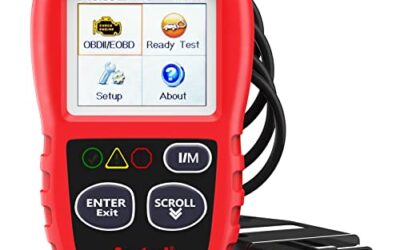
The ANCEL AD410 Enhanced OBD2 Scanner is the stronger fit for a driver who wants low-cost access to common engine codes without using a phone. Its built-in lookup database can show definitions for more than 42,000 DTCs. That helps a beginner understand whether a code points toward an ignition, fuel, emissions, or sensor issue before discussing repairs with a shop.
The scanner handles the main OBD2 jobs: reading and clearing codes, viewing freeze-frame data, checking I/M readiness, viewing live data, checking O2 sensors, running an EVAP test, and retrieving vehicle information. Freeze-frame data matters because it records operating conditions linked to a fault. Live data adds current values such as RPM, coolant temperature, fuel trim, and oxygen sensor readings.
Its 2.4-inch color display keeps the process separate from a phone, account, wireless connection, or app. The vehicle supplies power through its diagnostic port. Plug in the 16-pin connector, switch the ignition on, and open the scan menu. This setup suits occasional use in a household garage, especially for someone who wants code definitions on the tool itself.
Readiness information also helps after repairs. A cleared code does not mean every emissions monitor has completed its drive cycle. The AD410 can show monitor status before an inspection, which helps avoid arriving with an incomplete system.
Its drawback is scope. The AD410 reads engine and emissions codes only. It cannot scan ABS or SRS, control vehicle components bidirectionally, read transmission systems, or perform service resets. Skip it if the warning light belongs to an airbag, brake, stability, transmission, or maintenance system. A vehicle-specific or multi-system scan tool fits that job better.
Who should buy the AD410
- Drivers who want built-in code definitions instead of a separate reference search.
- DIY owners checking a check engine light before visiting a repair shop.
- Buyers who want live data, freeze frame, EVAP, O2, and readiness functions at a budget position.
- Users who prefer a wired scanner with no phone app, battery, charger, or Bluetooth connection.
FOXWELL NT301: best for live data and emissions checks
The FOXWELL NT301 OBD2 Scanner Live Data makes more sense for a home mechanic who expects to spend time watching sensor behavior. Its listing describes graphing and logging for available data such as oxygen sensors, fuel trims, coolant temperature, and RPM. A graph can make a changing value easier to follow than a static number, especially during a repeatable idle or road-side diagnostic check.
The 2.8-inch color screen gives the NT301 a small size advantage over the AD410. A larger display can reduce scrolling when several parameters appear on screen, though screen size alone does not determine diagnostic usefulness. The scanner also includes dedicated I/M readiness controls and red, yellow, and green indicator lights. Those controls suit drivers who regularly prepare a vehicle for an emissions inspection.
Foxwell lists O2 sensor and EVAP system leak monitor functions among its advanced OBD2 modes. These remain emissions-related checks, not complete component repairs. An EVAP result can point toward a fuel-vapor system concern, but it does not identify every failed part or replace a smoke machine, wiring check, or professional diagnosis.
The NT301 can read and clear diagnostic trouble codes, retrieve the VIN, display live data, and reset monitors. Its listing also says it supports 12V diesel vehicles equipped with OBD2. That detail helps narrow the choice for an owner of a compatible light-duty diesel, while voltage and OBD2 equipment still matter.
The main drawback is its narrow system coverage. It does not scan ABS, SRS, EPB, air conditioning, battery systems, or other advanced systems. It also does not offer bidirectional control, calibration, or advanced reset functions. Skip it if the purchase goal is airbag diagnosis, brake electronics, transmission work, battery registration, or actuator control.
Foxwell states that the NT301 includes lifetime updates and a one-year seller assurance. Those ownership benefits may matter to a buyer who plans to keep one wired scanner for occasional future use. They do not expand the tool into a full-system diagnostic platform.
Who should buy the NT301
- DIY mechanics who want live-data graphs and logging.
- Drivers who check emissions readiness often and prefer dedicated controls.
- Owners of compatible 12V OBD2 diesel vehicles who need a stated diesel-use option.
- Buyers who value a larger display and the listed lifetime update benefit.
Where the two scanners match
Neither scanner needs an internal battery, wall charger, Bluetooth pairing, or phone operating system. The vehicle’s diagnostic port supplies power. That reduces setup steps, but it also means a dead vehicle battery, damaged DLC, blown diagnostic fuse, or wiring fault can prevent communication.
Both tools support the common OBD2 protocols named in their listings. Both target vehicles sold in the United States from the 1996 model year onward, while European and Asian coverage begins with many 2000 and newer vehicles. The word “most” matters. OBD2 adoption, protocol support, and feature access can vary by vehicle and market.
Each scanner can clear a code after repair, but clearing does not repair the fault. If the underlying problem remains, the warning code can return. Clearing codes can also remove stored information that a technician may want. Record codes and freeze-frame details before clearing them, especially when the vehicle is still drivable.
Both products also stop short of professional system access. A check engine reader can identify a starting point. It cannot promise a failed sensor, prove a catalytic converter needs replacement, or replace wiring checks and service-manual procedures.
Choosing by repair situation
For one check engine light
Choose the AD410 when code definitions are the priority. Its built-in lookup feature gives a new DIY owner context without moving between the scanner and another device. The NT301 remains suitable, but its strongest difference is live-data presentation rather than code lookup.
For live sensor diagnosis
Choose the NT301 when graphing and logging matter. Fuel trims, coolant temperature, RPM, and oxygen sensor readings can become easier to interpret when viewed as changing trends. The data still needs vehicle-specific reference values and diagnostic reasoning. A changing graph is evidence to investigate, not a repair verdict.
For emissions readiness
Either scanner fits a driver checking I/M readiness before an inspection. The NT301 gives this task more visible emphasis through dedicated controls and indicator lights. The AD410 adds freeze-frame and code-definition features that may help after a repair.
For ABS, airbags, or service resets
Buy neither scanner for those tasks. Their stated coverage excludes major non-engine systems and advanced functions. Look for a scanner that explicitly names the target system, vehicle coverage, and required service function. A generic OBD2 label does not prove access to manufacturer-specific modules.
Ownership limits that affect both choices
Compatibility is the first ownership question. The connector may physically fit while a vehicle remains outside the scanner’s supported coverage. Confirm the vehicle’s market, model year, engine, and diagnostic system before purchase. On a compatible vehicle, ignition must be on for code reading, and the diagnostic port must have power.
Neither tool is a repair manual. Code definitions describe a monitored fault, not always the failed part. For example, a fuel-trim code can involve air leaks, fuel delivery, exhaust leaks, sensor errors, or wiring. Use live data as one input alongside symptoms, inspection, voltage checks, and service information.
Maintenance is modest because both units draw power from the vehicle during use and require no separate battery charging. Store the scanner and cable where the connector will not be bent. Do not leave either device connected during long periods of vehicle storage unless the vehicle and tool instructions allow it.
For broader selection criteria, the OBD2 scanners and diagnostic tools buying guide covers the difference between basic code readers and wider diagnostic platforms. Readers focused on live values can also compare the live data scan tool guide.
Which scanner should you buy?
Pick the ANCEL AD410 Enhanced OBD2 Scanner for the common driver who wants affordable check engine diagnosis, built-in code definitions, readiness checks, freeze-frame data, and live engine information. Its no-app setup keeps ownership simple, while its limitations remain clear: engine and emissions access only.
Pick the FOXWELL NT301 OBD2 Scanner Live Data when graphing, logging, a larger screen, dedicated I/M controls, or stated 12V OBD2 diesel support matter more. Its listed lifetime updates add value for a buyer planning longer ownership, but the scanner still cannot handle ABS, SRS, transmission, battery, or advanced service work.
Do not buy either product if the goal is full-module diagnosis, bidirectional control, calibration, battery registration, or manufacturer-specific resets. Look for a scan tool that explicitly supports those systems on the exact vehicle. For basic engine and emissions work, the AD410 is the better value choice. For richer live-data viewing, the NT301 earns the upgrade.
Next step: OBD2 Scanner Buying Guide for Beginners.