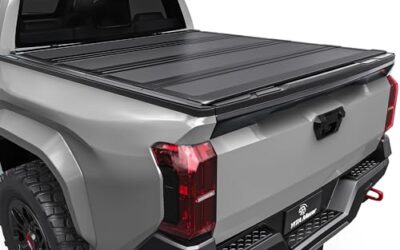
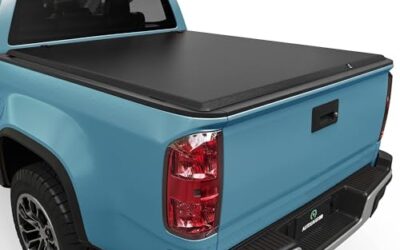
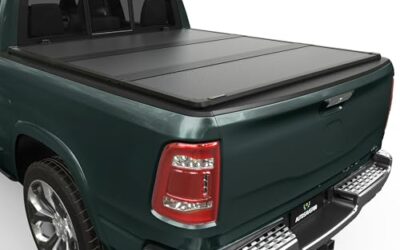
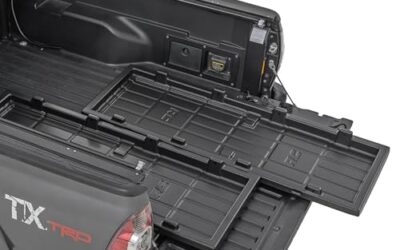
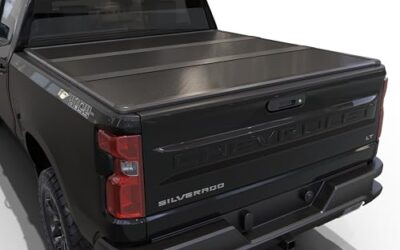
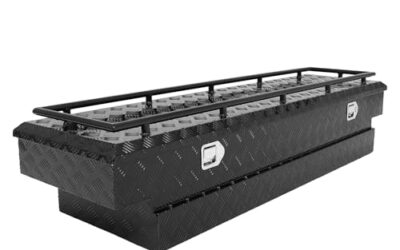
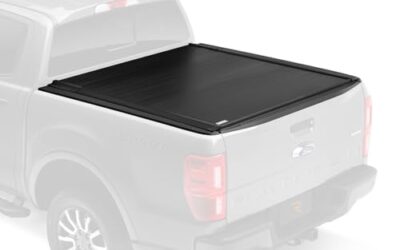
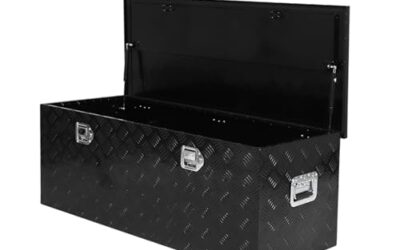
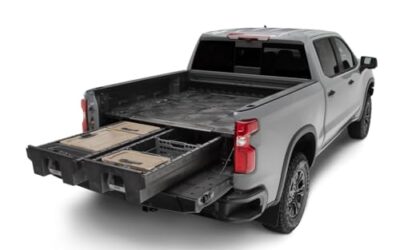
To check tonneau cover clearance with a toolbox, measure the box, lid, and cover at their closest points, then compare those dimensions with the truck bed and each product’s fit requirements. You need a tape measure, a straightedge, and the exact truck model year, bed length, cover model, and toolbox dimensions; a gap measured with the cover closed does not prove the lid or cover can move freely.
Key takeaways
- Measure toolbox height, length, width, lid movement, hinges, and mounting hardware.
- Measure cover rails and the underside of the closed cover, not just the visible panel.
- Check clearance at the front of the bed and along both sides. Uneven beds or mounts can change the gap.
- Account for how the cover opens and how the toolbox lid opens. Static clearance alone can miss a collision.
- Use fitment information for the exact truck year, bed, cover, and toolbox. Similar model names do not guarantee matching dimensions.
What clearance means for a toolbox and tonneau cover
Clearance is the open space between toolbox parts and tonneau-cover parts when both are installed. The relevant gap may be vertical, horizontal, or both. For example, a box can fit below a closed cover but still block a folding panel, a retracting cover, or the toolbox lid.
There is no single clearance number that applies to every truck. Bed shape, rail caps, cover rails, mounting brackets, toolbox position, and lid design all affect the fit. Even trucks with the same model name can differ by model year, bed length, trim, or factory equipment.
Start with the product instructions and fitment details for your specific setup. If you are comparing cover styles or planning a toolbox installation, the F-150 tonneau cover and toolbox fit guide covers fitment as a vehicle-specific decision. It cannot establish fit for another truck or a different toolbox.
What to measure before checking fit
- Truck: Record model year, bed length, cab configuration, and any bed-rail caps or accessories that affect the mounting area.
- Toolbox: Measure its outside width, front-to-back length, and height from its actual mounting surface. Include feet, brackets, handles, hinges, and any raised lid edges.
- Toolbox lid: Note the lid’s opening direction and how far it rises or swings. A closed-lid measurement does not show its full movement envelope.
- Cover: Identify the cover’s rails, brackets, seals, front header, and underside. Check how its panels or canister move during opening.
- Mounting positions: Record where the toolbox and cover rails sit in relation to the bed rails and front wall. Position changes can alter clearance.
Use a straightedge to extend a surface when a tape measure cannot reach the point directly. Keep measurements tied to a clear reference, such as the top of the bed rail or the toolbox mounting base. Write down each dimension and where you measured it. Mixing measurements taken from different reference points can make a fit appear better or worse than it is.
How to check tonneau cover clearance with a toolbox
- Confirm the exact parts. Identify the truck’s model year and bed, the toolbox model or dimensions, and the tonneau cover model. Check each maker’s fitment guidance for that combination. A general statement that a cover fits the truck does not necessarily mean it clears a toolbox.
- Check the bed and mounting area. Look for rail caps, tie-downs, bed liners, brackets, or other parts that change usable space. Follow the instructions for both accessories when choosing mounting locations. Do not assume that a box can sit in the same position with every cover rail system.
- Measure the toolbox from its mounting surface. Measure to the highest fixed point, then separately account for the lid, hinges, handles, and hardware. If the box is already installed, measure its actual position rather than relying only on catalog dimensions.
- Measure the cover’s lowest point. With the cover installed according to its instructions, identify the lowest part above the toolbox area. This may be a rail, bracket, seal, panel, or other component rather than the broad cover surface. Measure the vertical gap from the toolbox’s highest fixed point to that cover part.
- Check front-to-back and side-to-side fit. Compare the toolbox footprint with the cover rails and any front hardware. A box may have enough height clearance but still overlap a rail, hinge, or front header. Check both sides because the box or bed may not sit perfectly centered.
- Test every opening path. With the installation instructions followed, operate the cover through its normal opening and closing range. Open the toolbox lid through its intended range as well. Watch for contact, binding, or a lid that cannot open as intended. Do not force either part past resistance.
- Recheck after mounting. Tightening mounts or shifting the toolbox can change its position. Recheck the closest gaps and movement after installation, following the instructions for each accessory.
Do not place fingers between moving panels, rails, or a closing lid while checking for contact. If a cover is heavy or needs more than one person to handle safely, follow its installation instructions and get help rather than balancing it over the bed.
Record measurements in one place
| Check | Measure or observe | Why it matters |
|---|---|---|
| Toolbox height | Mounting surface to highest fixed point | Shows whether the closed cover can clear the box. |
| Lid and hinge envelope | Highest and farthest points during opening | Shows whether the box lid can move without hitting the cover. |
| Cover underside | Lowest point above the toolbox area | Rails or hardware may sit lower than the main panel. |
| Toolbox footprint | Width and front-to-back length | Reveals overlap with rails, brackets, or front hardware. |
| Cover movement | Parts that travel, fold, or retract | Identifies collisions that a closed-position check misses. |
| Installed position | Distance from bed references on each side | Shows whether shifting or uneven placement changes the gap. |
How to interpret the measurements
A positive measured gap only describes the position and conditions you checked. It does not automatically account for a different mounting location, a changed cover adjustment, or movement while driving. Do not treat a small gap as proof of compatibility when the cover or toolbox contacts another part during operation.
If the cover maker gives a minimum clearance or specific toolbox restrictions, use those instructions rather than a general measurement rule. If dimensions come from separate product listings, compare their measurement reference points first. One height may include mounting feet while another starts at the bottom of the box, making a direct comparison misleading.
For a retractable cover, include the canister and travel path. For a folding or hinged cover, check panel movement and the space needed to fold or lift it. A roll-up cover may still have rails, clamps, or front hardware that interfere with a box. The cover style alone does not establish compatibility.
If the truck is a GMC Sierra, bed configuration and fitment details still matter. The GMC Sierra 1500 cover fitment guide discusses why vehicle-specific fit should come before a general cover description.
Common mistakes
- Measuring only the closed cover: That misses collisions while panels fold, retract, or lift.
- Measuring only the toolbox shell: Hinges, handles, mounting feet, and the open lid can set the real clearance limit.
- Using bed width as the only fit check: Width does not show vertical clearance or whether rails and brackets overlap the box.
- Assuming the box can move anywhere: Moving it may conflict with cover clamps, bed accessories, or the toolbox mounting instructions.
- Relying on a different truck’s fit: Model year, bed length, rail caps, and accessory combinations can change the installation.
- Forcing a tight cover closed: Contact or resistance can point to interference or incorrect installation. Stop and inspect rather than forcing the mechanism.
When to get professional help
Ask an installer or the accessory makers for guidance if the fit instructions conflict, the cover binds, mounting points do not line up, or the toolbox needs to sit where a cover rail or clamp belongs. Get help if resolving interference would require drilling, cutting, bending, or changing a mounting system. Those changes can affect fit and operation, and the correct approach depends on the parts and truck.
Take your written measurements, truck model year and bed details, and the exact accessory models. That gives an installer enough context to assess the actual combination instead of relying on a generic toolbox or cover size.
Gear that can help
If you need tonneau covers for this job, these picks already appear in our tonneau covers guides. Check the full guide for fit and who should skip each one.

Pros
- Broad stated compatibility across specified Dodge Ram 1500 model years and body configurations
- FRP and PP honeycomb construction is listed for resistance to scratches and wear
- No-drill installation design
- Provides a locking function when the tailgate is closed
Cons
- Fitment is limited to specified Dodge Ram 1500 configurations with a 5.7-foot bed
- Installation relies on six clamps rather than a drilled mounting method
Specifications
| Color | black |
|---|---|
| Size | 5'7" |
| Dimensions | 71.65 x 26.37 x 5.7 inches |
| Product Group | Automotive Parts and Accessories |
| Binding | Automotive |
Best For / Avoid If
Best for buyers prioritizing
- Broad stated compatibility across specified Dodge Ram 1500 model years and body configurations
- FRP and PP honeycomb construction is listed for resistance to scratches and wear
- No-drill installation design
Consider another option if
- Fitment is limited to specified Dodge Ram 1500 configurations with a 5.7-foot bed
- Installation relies on six clamps rather than a drilled mounting method

Pros
- Specified compatibility with 2015-2026 Ford F150 5.5-foot beds
- Tool-free, no-drill attachment and removal
- Hard-shell panels made from EnduraShield automotive-grade polymer
- Folding design provides bed access
Cons
- Compatibility is limited to the listed Ford F150 5.5-foot, 66-inch bed application
- Full bed access requires removing the cover
Specifications
| Size | 5.5ft Bed |
|---|---|
| Product Group | Automotive Parts and Accessories |
Best For / Avoid If
Best for buyers prioritizing
- Specified compatibility with 2015-2026 Ford F150 5.5-foot beds
- Tool-free, no-drill attachment and removal
- Hard-shell panels made from EnduraShield automotive-grade polymer
Consider another option if
- Compatibility is limited to the listed Ford F150 5.5-foot, 66-inch bed application
- Full bed access requires removing the cover

Pros
- Provides full bed access when rolled up
- Adjustable tension system is designed to keep the vinyl tight and wrinkle-free
- No-drill installation hardware is included
- Uses marine-grade vinyl with aluminum side rails and stainless steel clamps
Cons
- Not compatible with 2019 Silverado 1500 LD, Sierra 1500 Limited, CarbonPro beds, or factory side storage boxes
- Equipping the cover will interfere with the power tailgate
- Small holes must be cut in over-the-bedrail bedliners for proper clamp installation
Specifications
| Color | Black |
|---|---|
| Size | 5.9ft Bed |
| Dimensions | 72.56 x 68.82 x 1.3 inches |
| Weight | 21.61 pounds |
| Product Group | Automotive Parts and Accessories |
| Binding | Automotive |
Best For / Avoid If
Best for buyers prioritizing
- Provides full bed access when rolled up
- Adjustable tension system is designed to keep the vinyl tight and wrinkle-free
- No-drill installation hardware is included
Consider another option if
- Not compatible with 2019 Silverado 1500 LD, Sierra 1500 Limited, CarbonPro beds, or factory side storage boxes
- Equipping the cover will interfere with the power tailgate
- Small holes must be cut in over-the-bedrail bedliners for proper clamp installation
FAQ
Can I check clearance before buying either accessory?
Yes, if you have reliable dimensions and fitment information for both parts. Compare the toolbox’s mounting height and footprint with the cover’s rails, underside, and movement path. Treat catalog dimensions as useful only when their measurement points match your planned installation.
Does a low-profile toolbox always fit under a tonneau cover?
No. A lower box may improve vertical space, but its lid, hinges, width, or mounting brackets can still interfere. The cover’s rails and opening path also matter.
Should I leave extra space beyond the measured gap?
Use any clearance margin or restriction required by the cover and toolbox instructions. There is no universal extra-gap figure that applies to every truck and accessory combination. If the instructions do not answer a tight-fit question, ask the makers or an installer before changing the mount positions.
Can I use a toolbox with any tonneau cover style?
No. Some combinations may fit, while others conflict with rails, a canister, folding panels, or lid movement. Check the exact truck, bed, toolbox, and cover combination rather than relying on cover style alone.