Direct TPMS measures tire pressure with sensors associated with the wheels and sends readings to a receiver. Indirect TPMS uses vehicle sensor data, commonly ABS wheel-speed signals, to infer changes consistent with underinflation. Neither replaces checking cold tire pressure with an accurate gauge.
The system fitted to your vehicle is determined by its design. This is not normally a setting you can switch between in a menu. Equipment, displays and service procedures vary by model and year.
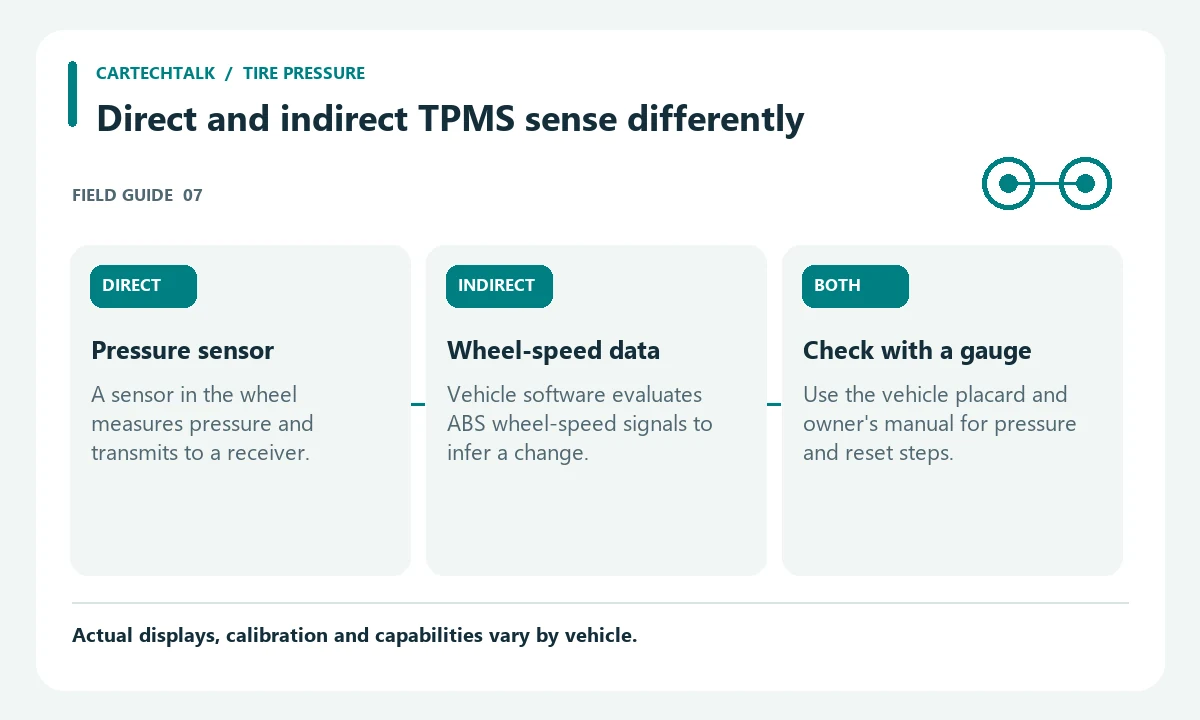
Direct vs indirect TPMS at a glance
| Feature | Direct TPMS | Indirect TPMS |
|---|---|---|
| Input | Pressure-sensor transmissions | Wheel-speed and other vehicle data, depending on design |
| Individual pressure display | Available on some vehicles, not guaranteed | Do not assume a measured pressure readout is available |
| Wheel service | May require sensor compatibility checks and relearn | May require initialization after pressures or tires change |
| Routine pressure check | Still needed with a gauge | Still needed with a gauge |
How direct TPMS works
A direct system uses wheel-mounted sensors that measure pressure and transmit information to the vehicle. Depending on the design, the instrument panel may show individual pressures or only a warning. The sensor protocol, operating frequency, part number and relearn method must match the application; a product advertised as universal is not proof of fit.
When wheels or sensors are serviced, consult the vehicle procedure and the sensor manufacturer’s application information. Some sensors require programming before installation, and relearning a sensor ID is not necessarily the same operation as programming a replacement sensor.
How indirect TPMS works
Indirect systems analyze vehicle signals rather than reading pressure directly from a pressure transducer in each wheel. Their capabilities depend on the generation and vehicle software. Avoid general claims that every indirect system misses simultaneous losses or that one technology is always safer in every vehicle.
Set cold pressures to the placard values before performing the prescribed initialization or calibration. Resetting with the wrong starting pressures can establish an incorrect reference. Follow the required driving procedure where the vehicle manual specifies one.
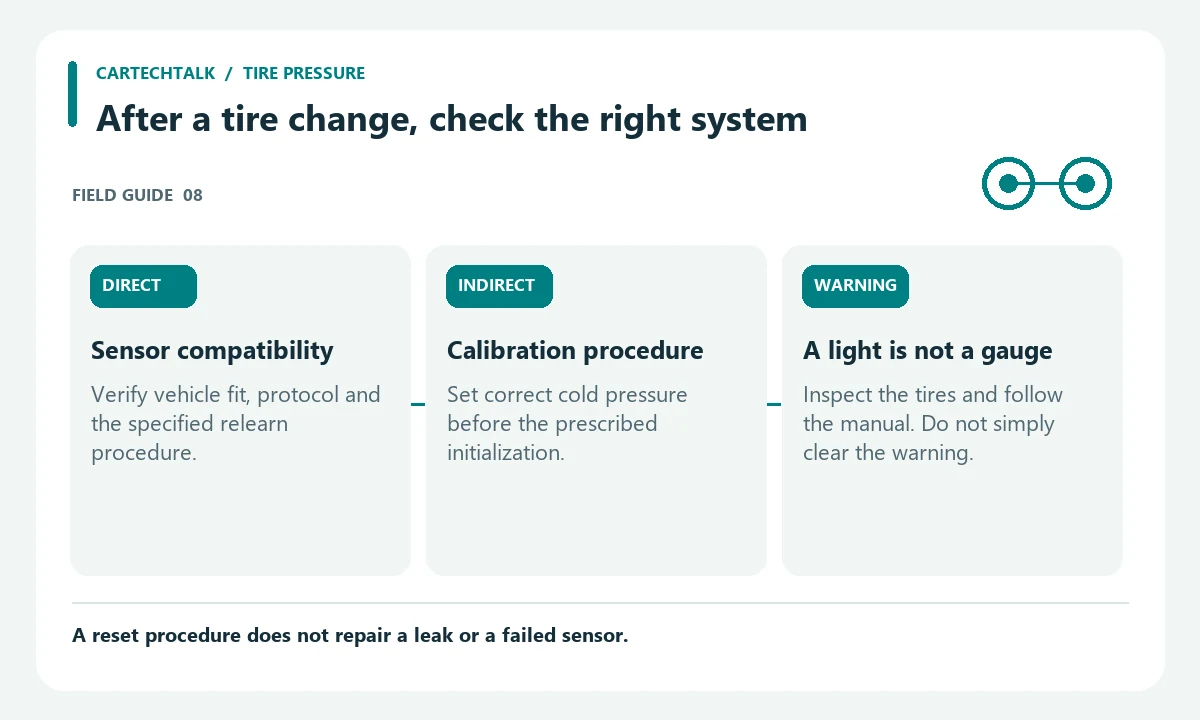
How to identify the system on your car
Start with the owner’s manual or vehicle-specific service information. Individual pressure displays can be a clue, but a valve stem’s appearance alone is not a reliable identification method. If you are ordering sensors or tools, verify the VIN/application, model year and market with a qualified tire service provider.
What to do when the warning appears
Follow the vehicle’s instructions for the warning pattern. Inspect for visible damage and check the tires with a gauge when safe; stop driving if a tire is visibly flat or the vehicle handles abnormally. Use the vehicle placard’s recommended cold pressure, not the maximum pressure molded into the tire sidewall. Persistent or malfunction warnings need diagnosis rather than repeated resets.
Readers weighing these picks also look at How to Reset a TPMS Sensor, How to Check Aftermarket TPMS Sensor Batteries and How To Check Tire Pressure Without A TPMS Display.
Pros and cons of each system
| Direct TPMS | Indirect TPMS | |
|---|---|---|
| Strengths | Reads pressure from each wheel sensor; some vehicles show the pressure for every tire | No pressure sensors in the wheels to maintain; uses data the vehicle already collects |
| Limitations | Sensors have batteries and can fail; tire and wheel service may need sensor handling, programming or relearn steps | Infers pressure loss from wheel behavior, so it may not show individual pressures; needs a correct reset after inflation or tire changes |
| Typical service tasks | Sensor replacement, programming, relearn | Inflate to placard values, then run the reset or calibration procedure |
Neither system replaces a regular check with a tire gauge. Both are designed to warn about significant pressure loss, not to keep pressures at the ideal value, so check your tires when they are cold and set them to the placard on the driver’s door jamb.
Frequently asked questions
Can I add an aftermarket monitor?
A separate aftermarket system may provide its own readings, but it does not automatically replace or integrate with the factory system. Verify its pressure range, vehicle use and installation instructions.
Do I need a TPMS tool?
Only if the vehicle and task call for one. A basic pressure check needs a suitable gauge; programming, activation and relearn capabilities are different tool functions.
Which system should I choose?
For an existing vehicle, understand and maintain its fitted system. When buying a car, compare actual functions and service requirements rather than a direct/indirect label alone.